
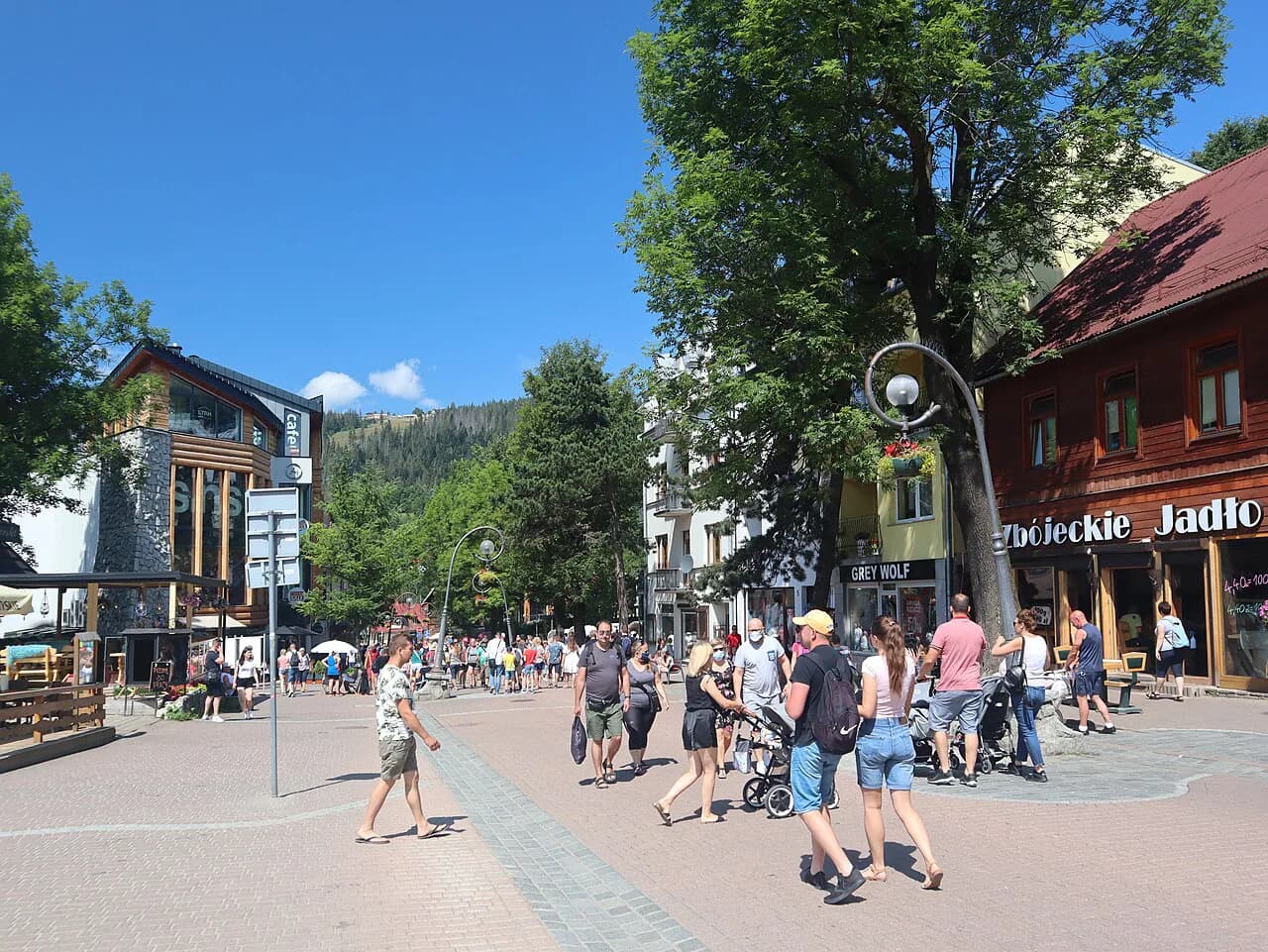
Krupówki: Zakopane's Main Promenade

Krupówki is Zakopane's answer to a high street and a mountain viewpoint rolled into one: a car-free promenade of roughly 1.1 km, paved with granite setts, where almost every visitor to the town ends up at least once. The street runs to about 1,080 m, so treat it as a kilometre of strolling rather than a hike. This page covers where the street runs, what you pass along the way, what to eat, which end to start from and how much time to give it.
Where Krupówki runs and how to get your bearings
The street begins where Nowotarska and Kościeliska meet and continues to the junction with Witkiewicza and Tetmajera, which gives you two clear map anchors for finding it. Knowing which cross-street you are nearest saves a lot of vague wandering, because the promenade is long enough that the two ends feel like different places.
Zakopane has no metro or tram network to learn, so orientation on foot is straightforward: find one of those junctions and you are on the promenade. The name comes from the Krupówki glade, and the route began as a narrow path linking Kościeliska Street with Kuźnice, running among scattered buildings and meadows before it became the town's main axis.
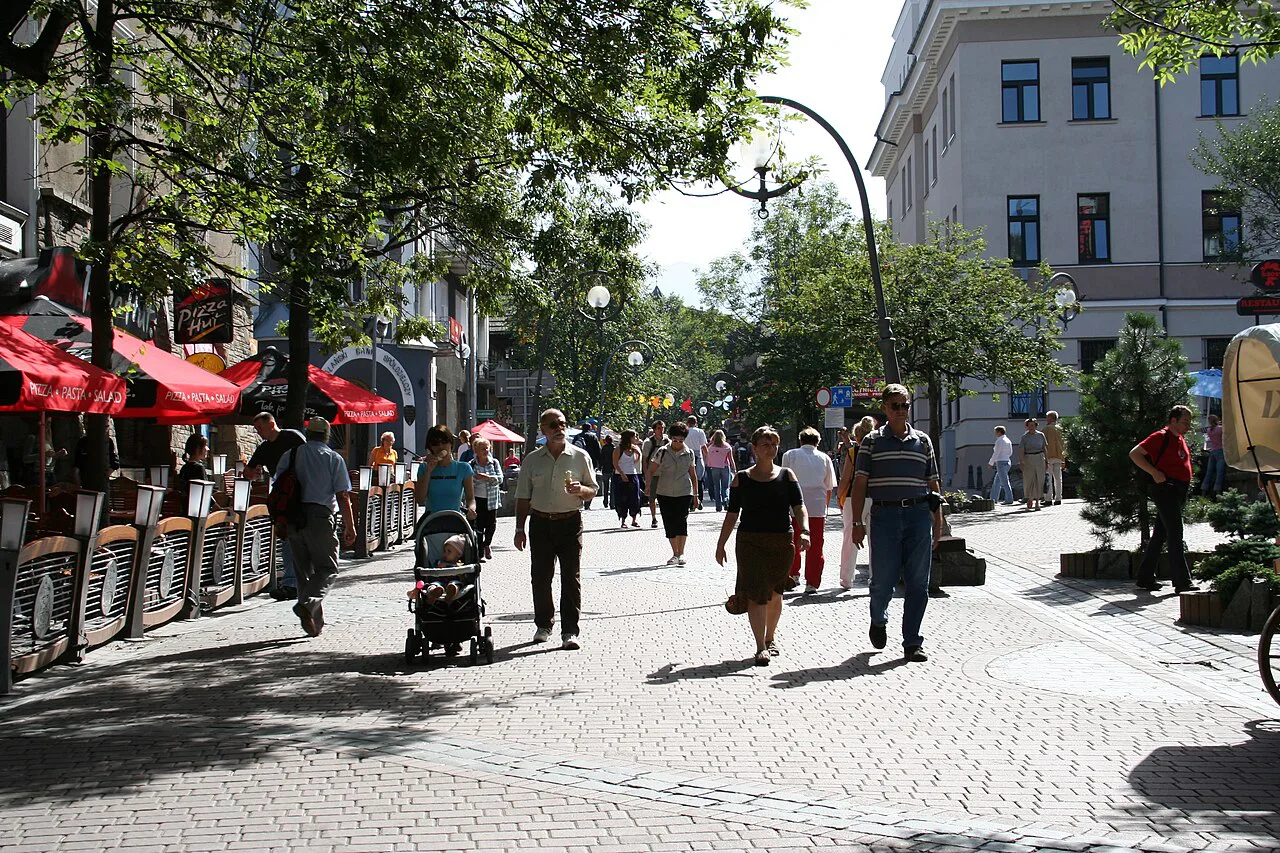

Lower and upper Krupówki: which end you are on
The lower stretch is the commercial, camera-facing end, with shops, restaurants and the souvenir trade in full flow. A live camera fixed on Lower Krupówki notes that from its position to the end of the promenade there is almost 900 m of walking, which tells you the street is genuinely long rather than a single square in disguise.
The upper end has fewer of the big souvenir displays and the street still carries shops and eateries, but the mountain framing is not confined to one end: from the right spot you can pick out Gubałówka and the Tatras, including from the lower promenade as well. If you only have a short window, walking the full length once in either direction covers the views and the commercial stretch. For the surrounding sights beyond the street, the [Zakopane Attractions: 7 Visitor Guides] hub sets out the rest of the town.
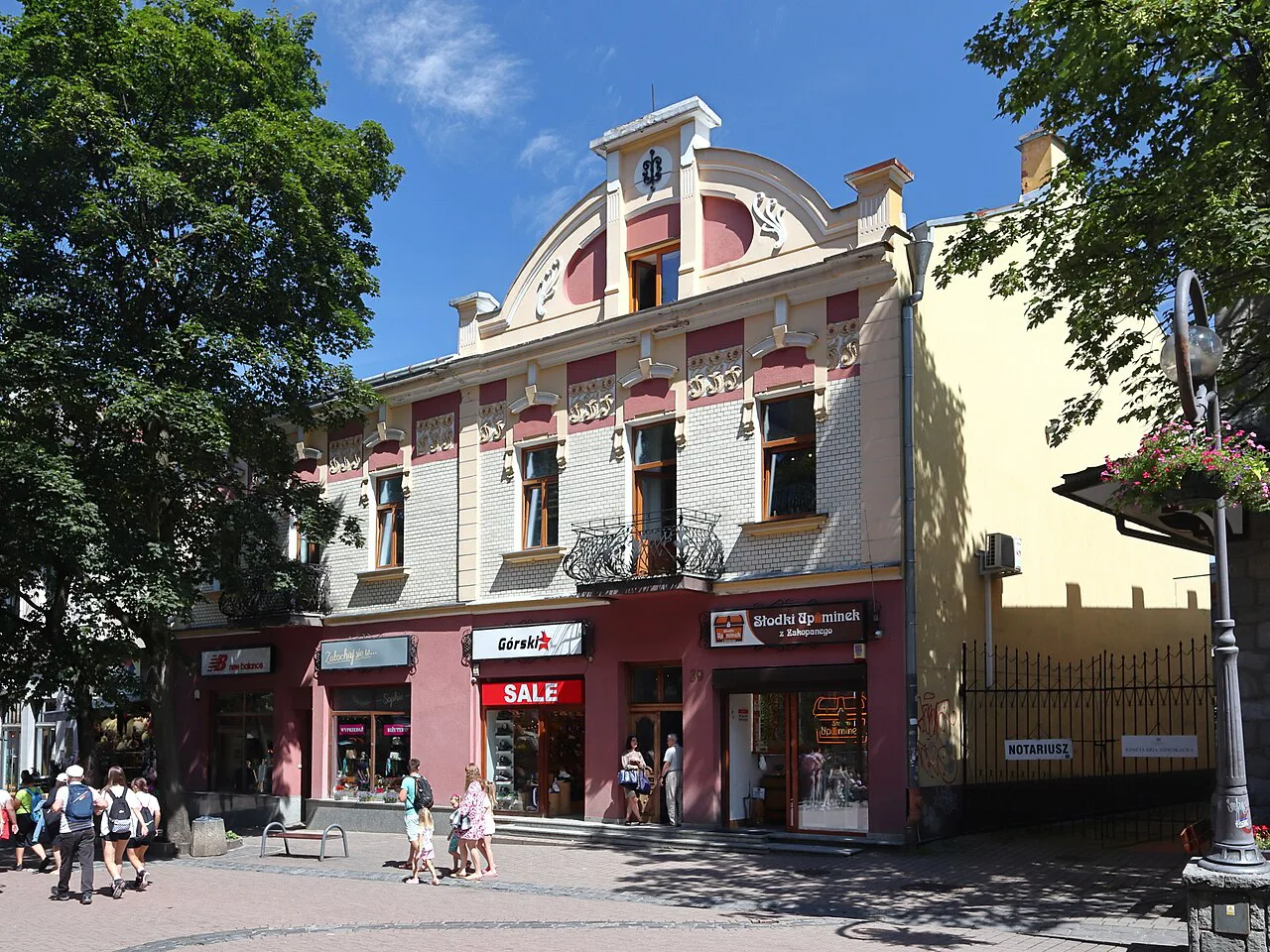

What you actually see along the way
Expect gift stalls, regional food shops, horse-drawn carriages and a photo spot with the Zakopane bear, all packed into a street closed to car traffic. The car ban is what makes it work: it is a promenade rather than a road, and pedestrians get the whole width.
You can buy oscypek, the smoked sheep's cheese that is Podhale's signature snack, and the street also carries clothing shops well above cheese-buying budgets. The mix is exactly why opinions split so sharply.
The mountain views from the street
Walk looking up rather than into the shop windows and the payoff is Giewont, the crag known as the Sleeping Knight, plus the wider Tatra skyline. From the right spot on the promenade you can pick out Gubałówka ahead and the Tatras behind it.
If the peaks pull you away from the stalls, [Tatra National Park from Zakopane] explains the trails and rules for the mountains themselves, which is a different day out from a street stroll. For the ridge directly ahead of the lower promenade, [Gubałówka] covers the hill and its cable car.
What to eat: kwaśnica, placki and grilled oscypek
The karczmy and restaurants along the promenade serve traditional góralskie cooking, and the dishes to look for are kwaśnica, a sour cabbage soup usually made with ribs, placki po góralsku and grilled oscypek with cranberry. Portions tend to be mountain-sized, so one sit-down meal plus street snacks is usually plenty for a day.
Menus and prices vary from place to place, so read them before you sit down rather than assuming a fixed rate for the street. That habit matters more here than in most Polish cities because the promenade caters squarely to visitors.
Morning quiet, evening crowds and what rain does
On sunny mornings, when most visitors head for the ski slopes or mountain trails, the promenade empties out and fills again only in the evening. Rain reverses the pattern: Krupówki stays crowded all day when the weather closes in.
Use that rhythm deliberately. If you want photographs of the street rather than of other people's shoulders, go early and save the shops for the afternoon; if you are in town for the food and the atmosphere, evening is the livelier choice.
How long to allow and how it fits a short stay
An hour or two is enough to walk the full length, browse a little and stop for oscypek; add another hour if you sit down for a proper meal. It is not a museum-and-tickets kind of sight, so it slots easily around the rest of your day.
On a one- to three-day Zakopane break, treat Krupówki as the connective tissue rather than the headline: it works as a first-evening introduction to the town and as a route between other stops. If you are still choosing what to fill the days with, [things to do in Zakopane] covers the alternatives, from the [Tatra museum] to [Wielka Krokiew].
The honest trade-off
Some people call Krupówki the ugliest street in Poland; others think it is one of the prettiest. Both views are on record, and the reason is the same: a genuinely handsome mountain setting loaded with souvenir stalls and crowds.
It is busy almost all year round, so come expecting company rather than a quiet alpine lane. Read that as a description, not a warning: the street is popular because it is convenient, central and unmistakably Zakopane.
Nearby: the Gubałówka cable car and the rest of town
Walk down to the lower junction, continue straight on, and you reach the lower station of the Gubałówka cable car, one of Zakopane's key attractions. That makes the bottom of the promenade the natural place to end a walk and start the next thing.
Other worthwhile stops sit within walking distance of the street, including [Villa Koliba] in the Koliba style, and the higher mountains are a cable car ride away at [Kasprowy Wierch]. Pick one or two rather than trying to tick off everything in an afternoon.
Practical points before you set off
Krupówki is free to walk and needs no ticket, but food, souvenirs and carriage rides are all chargeable and the operators set their own rates. Ask for the price before you climb into a carriage or order from a stall, because nothing on the street is priced by a central authority.
Seasonal conditions change what the street looks like and how pleasant it is: snow and ice on the setts in winter, sun and crowds in summer. Weather and mountain conditions under the Tatras shift quickly, so check current details and the forecast once before you go.
Should Krupówki be on your Zakopane list?
Yes, but for an hour or two rather than a whole day. Walk the full length once, look up at Giewont, eat oscypek or a bowl of kwaśnica, and finish at the bottom of the street by the Gubałówka cable car.
If crowds and souvenir stalls are not your idea of a mountain town, go early on a sunny morning when many visitors head for the ski slopes and trails and the promenade is at its emptiest, then spend the rest of the day higher up. Either way, Krupówki is the easiest place in Zakopane to find your feet.
Frequently Asked Questions
Is Krupówki expensive?
It is the most visitor-facing street in Zakopane, so it caters to tourists rather than locals. Compare a couple of places before committing to a sit-down meal, and treat the promenade itself as a stroll rather than a ticketed sight.
What is the route of Krupówki from one end to the other?
It runs from the junction of Nowotarska and Kościeliska streets to the junction with Witkiewicza and Tetmajera streets, a little over a kilometre in total. The lower end is the commercial stretch and the upper end has the better mountain framing.
What events happen on Krupówki?
The promenade is Zakopane's main gathering street, but what is on at any given time varies, so check what is scheduled during your dates before you travel.