
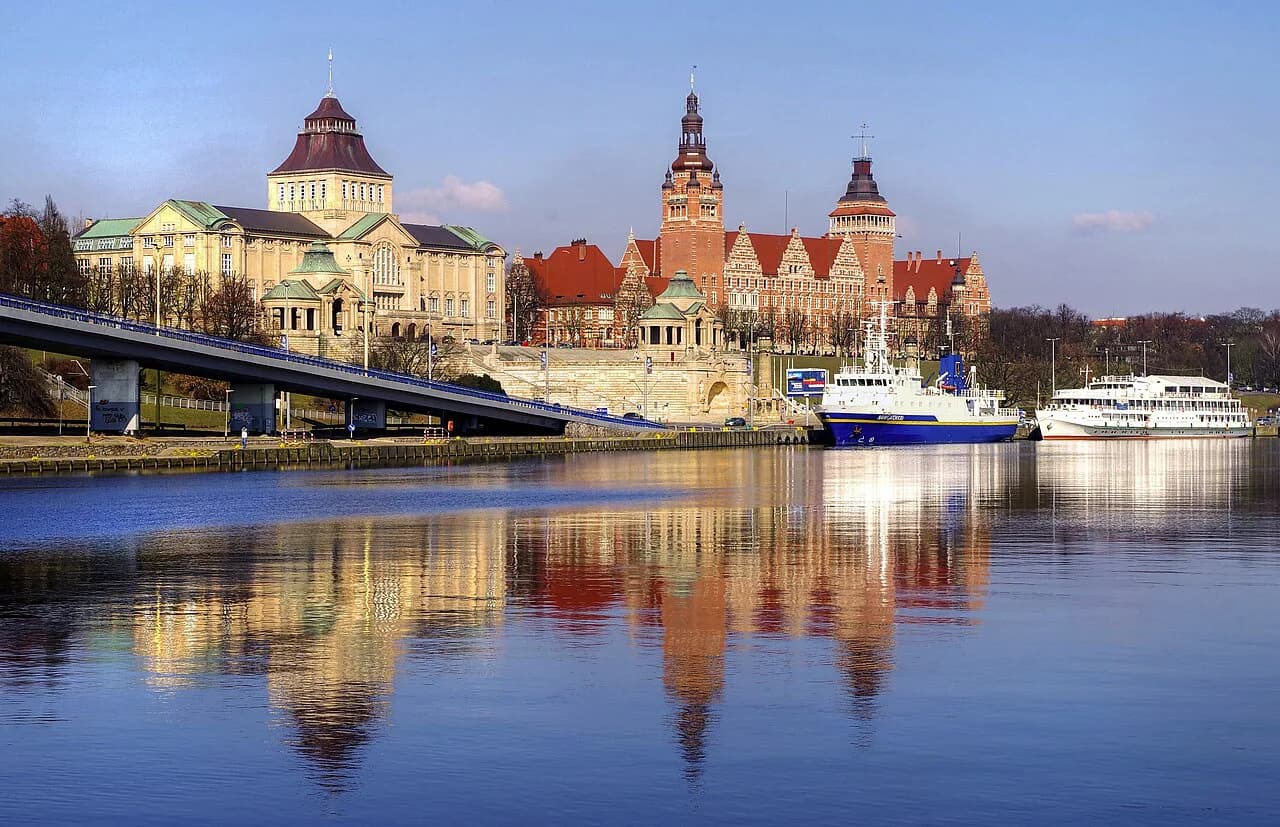
Wały Chrobrego, Szczecin: the Chrobry Embankment

Wały Chrobrego, known in English as the Chrobry Embankment, is a 500-metre stretch of viewing terraces above the Oder in central Szczecin. It is an open piece of city landscape rather than a ticketed attraction, so half an hour covers the promenade unless you add a museum or a concert. This guide covers what you look at from the top level, the buildings that frame the terraces, the walk in from Solidarity Square and the sights within a few minutes across the centre.
Where the terraces sit and how to reach them
The embankment runs along the river side of the city centre, a short walk from the Philharmonic along Małopolska Street. Coming from the centre, the natural approach is down John Paul II Avenue and Aleja Kwiatowa (Flower Street) to Solidarity Square, then along Małopolska to the terraces. Allow ten to fifteen minutes from Solidarity Square at an easy pace, and rather less coming back because the climb is the harder direction.
Because the terraces sit above the river, the site is split into levels joined by stairs rather than a single flat promenade. Treat the top as the viewpoint and the lower walks as the way down towards the water, and plan your loop so you finish at the level you want to leave from. Footwear matters more than it would on a flat square, and anyone with limited mobility should approach from the upper side.
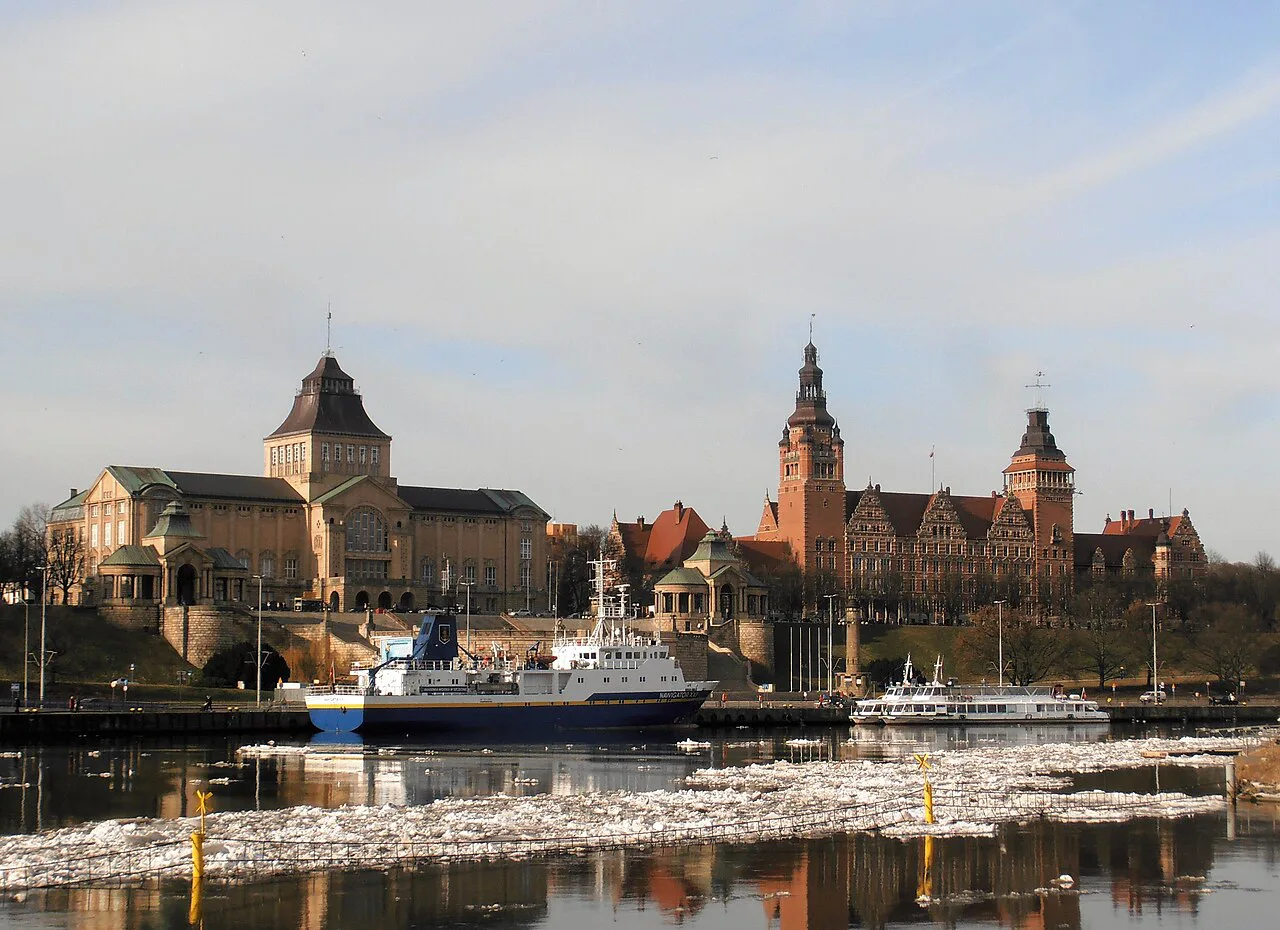

What you see from the top level
From the upper terrace you look out over the Oder and the working riverfront, which is why the height matters: the elevation lifts the view clear of the quays and gives the city a wide, open horizon. The composition is as much about the buildings behind you as the water in front, since the long facade frames the view like a stage set when you turn around. Come on a clear day and the panorama carries the visit; come in flat grey light and the architecture has to do the work.
The terraces form public ground above the river, so there is no fixed visiting slot to plan around. They are reached and crossed on foot, with stairs and changes of level between the top and the lower walks.
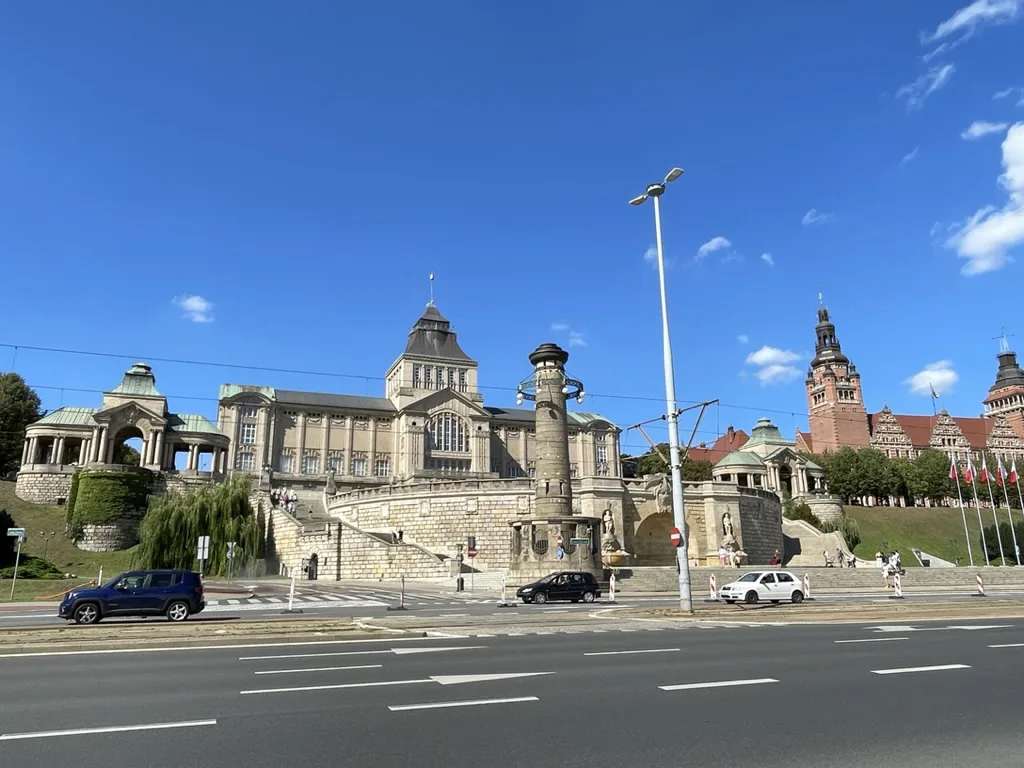

The buildings that frame the embankment
The most prominent building on the walk is the City Hall complex, built from 1924 as the seat of the Pomeranian provincial authorities on one of the city's main axes, next to today's Kasprowicz Park. The neo-Baroque block is finished in dark green plaster, with a carved Pomeranian griffin crowning the central avant-corps and coats of arms of Pomeranian cities on the wings. A short detour inland brings its green facade into view, so give it a proper look alongside the river panorama.
The griffin is Szczecin's own emblem, so once you start noticing it on facades, water pumps and the square in front of the Town Hall, the decoration of the embankment quarter reads as one continuous story. The creature pulled the chariots of the gods in legend and guarded treasure, which is a good reason it ended up on so many official buildings here.
The Philharmonic at Małopolska 48
The other building tied to the embankment walk is the Mieczysław Karłowicz Philharmonic at Małopolska 48, a white glass and aluminium structure that opened in 2014 and won the Mies van der Rohe Award in 2015. Its Symphony Hall seats nearly 1,000 and the smaller Chamber Hall nearly 200, with acoustics designed by the Barcelona specialist Higini Arau. The two-layer facade hides 25,000 LED fittings, so the building is worth a second pass after dark.
Concerts are a separate booking and the programme changes with each season, so buy through the Philharmonic rather than assuming you can walk in. Allow an hour around the building if you are only looking at the architecture, and an evening if you have a ticket.
Upheavals Dialogue Centre below the terrace
Below the terraces sits the Upheavals Dialogue Centre, a museum telling the story of Szczecin from the end of the Second World War to the fall of communism. It is the obvious indoor counterpart to the open view above, and the café by the exit serves herring sandwiches and paprykarz szczeciński, the city's paprika paste.
The centre runs its own opening days, closures and ticket prices, none of which are fixed by the embankment itself. Check the museum before you build a half-day around it, because a closed door changes the shape of the afternoon.
How long to allow
Budget 30 to 45 minutes for the terraces themselves: ten minutes at the top taking in the view, twenty walking the length and back, and the rest looking at the City Hall facade and the Philharmonic. Add an hour for the Philharmonic's exterior and lobby, or a full concert evening if you book. Add two hours or more for the Upheavals Dialogue Centre, which is a museum visit rather than a stroll.
Half a day covers the whole cluster comfortably on foot: Solidarity Square, the Philharmonic, the embankment and the museum, with a coffee in between. If you only have a couple of hours, choose the terraces plus one building and leave the rest.
When to come
Evening is the strongest time for the buildings, when the Philharmonic's facade lights up and the City Hall's green front takes on a different colour. Daylight hours suit the view from the top, since the river and the far bank need some visibility to be worth the climb.
What is nearby
Jasne Błonia and Kasprowicz Park are minutes inland from the City Hall, and the park's paths lead past the Helena Majdaniec Summer Theatre and a rose garden. This makes a natural green extension to a terrace walk if you want to keep going without another museum.
Anyone staying with art should cross to the National Museum in Szczecin, and industrial and transport collections are covered by the Museum of Technology and Transport in Szczecin on the other side of the centre. Both are separate venues with their own hours, so treat them as whole visits rather than quick stops.
The old city gate, Brama Portowa, is a short walk away and a useful orientation point when you are working out the layout of the centre on foot. For a wider set of options across the city, the full list of things to do in Szczecin fills in the rest of a one- to four-day break.
Is the embankment worth the walk?
Yes, as a free viewpoint and a piece of city architecture rather than a destination in its own right. Slot it at the end of a day that already includes the Philharmonic or the Upheavals Dialogue Centre, and the walk down to the Oder earns its place.
If you are tight on time, the terraces plus one interior make a solid half-day. If you have longer, the green run through Jasne Błonia and Kasprowicz Park turns the same walk into a full afternoon.
Frequently Asked Questions
Is Wały Chrobrego free to visit?
The terraces are open public ground above the Oder, with no ticket for the promenade and the view. The Philharmonic and the Upheavals Dialogue Centre near the terrace are separate venues with their own tickets, published by each venue.
Can you walk down to the river from the terraces?
The site is built on several levels above the river, joined by stairs, so you move between the top and the lower walks rather than strolling straight onto a quayside path. Plan your route so you finish at the level you want to leave from, and approach from the upper side if stairs are difficult.