
Księży Młyn, Łódź: the Factory District for a Half-Day

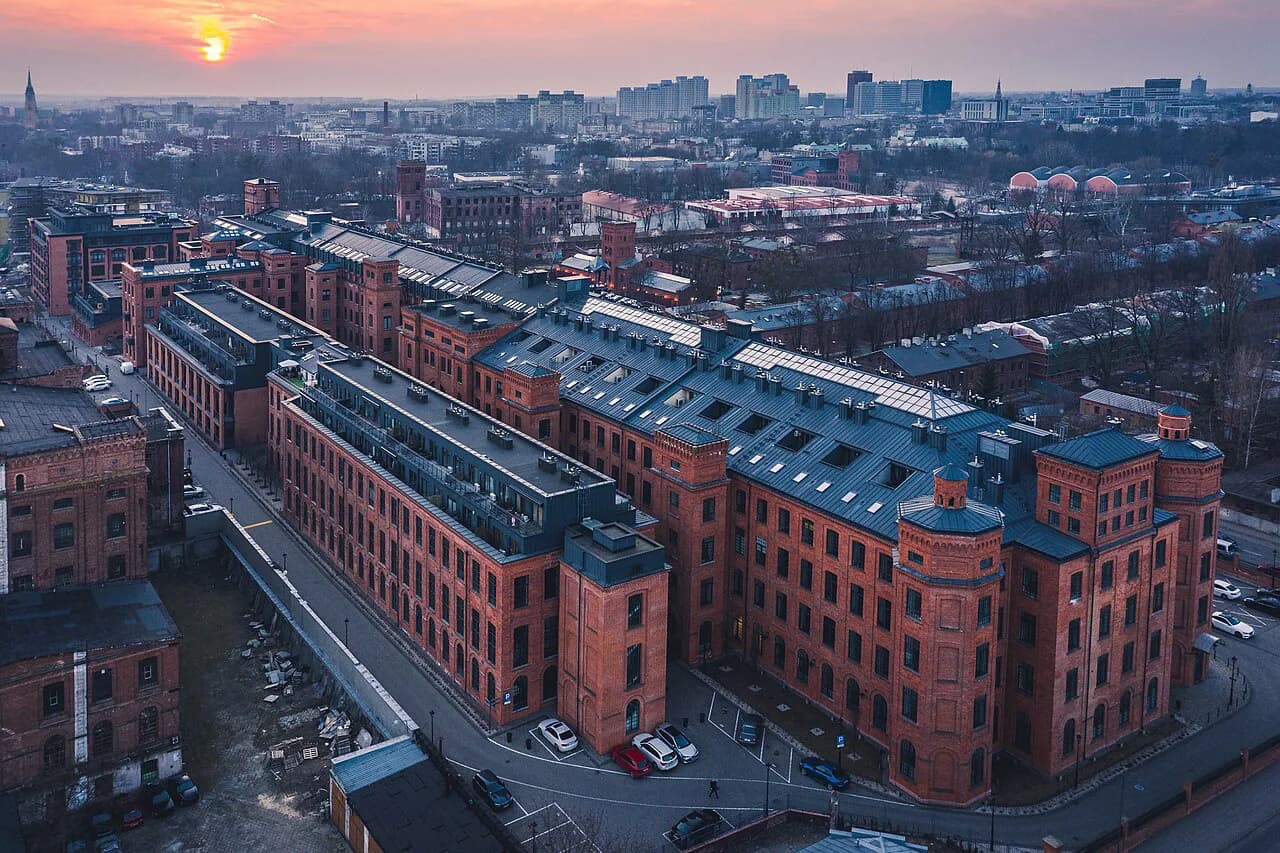
Give Księży Młyn half a day and treat it as a landscape to walk through, not a single ticketed sight. The draw is the red-brick workers' housing, the factory buildings and the Jasień river running through a district that Karol Scheibler expanded from the 1870s. This guide covers the district's layout, the public transport that reaches it, the free exhibition at the Marek Edelman Dialogue Center and how to fit the area into a Łódź city break.
What Księży Młyn is and why it is worth the trip
Księży Młyn is the former industrial colony built around the Scheibler cotton empire on Łódź's eastern side, and its appeal lies in the street pattern rather than a museum door. Long rows of brick workers' housing sit beside factory blocks and the small Jasień river, which once powered the mills. Walk it slowly and the district reads as a complete nineteenth-century company town, one of the clearest in Poland.
The district began earlier than Scheibler, with Krystian Wendisch, a specialist invited from Saxony in 1824 by Rajmund Rembieliński to build a mechanical spinning mill on the land. Wendisch expanded from 1825 and fitted the factory with hydraulic machinery driven by the Jasień in 1827; after his death the works passed between owners until Scheibler bought the old Wendisch grounds at the start of the 1870s. That sequence explains why the district feels both planned and layered.
For a sense of the whole, look at photographs of the district before you go, since the ensemble of brick housing and mill walls is the sight itself rather than any one building.

Where it sits in Łódź and how it is laid out
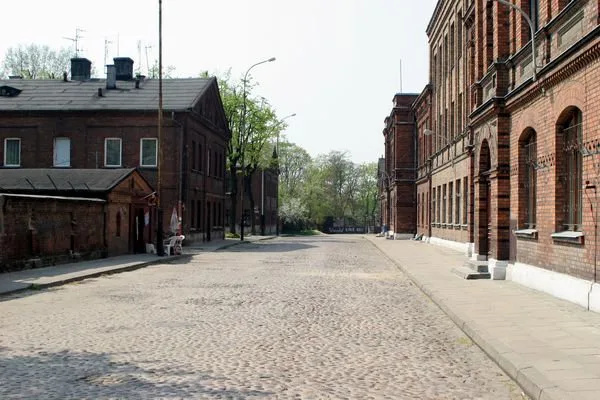
Księży Młyn lies east of the city centre, and its streets run in long, straight lines between mill buildings and housing rows. The spine is Przędzalniana, where the Wendisch house at number 71 still stands, while Wojska Polskiego carries the Dialogue Center at number 83. The Jasień is the quiet thread linking the two, and following it keeps you off the bigger roads.
Nearby, the tourist information point Centrum turysty Księży Młyn is listed at Księży Młyn 12, a useful landmark for orienting yourself at the district's edge. Plan your loop so you finish near the Dialogue Center rather than doubling back, since the streets are long and the walk between the far ends adds up. The layout is easy to grasp once you have crossed the district once.

How to get there: trams and buses near the district
Public transport drops you within walking distance of the mill streets. The Dialogue Center names buses 57 and 64 as the closest services, with 70 and 81 nearby, and trams 1 and 6 as the nearest with 5 close by; there is free parking on Wojska Polskiego and on Oblęgorska/Chłodna for drivers. A bicycle path runs along Wojska Polskiego and there are racks in front of the building, so cycling in through the parks is straightforward.
The Wendisch factory at Przędzalniana 71: the district's first chapter
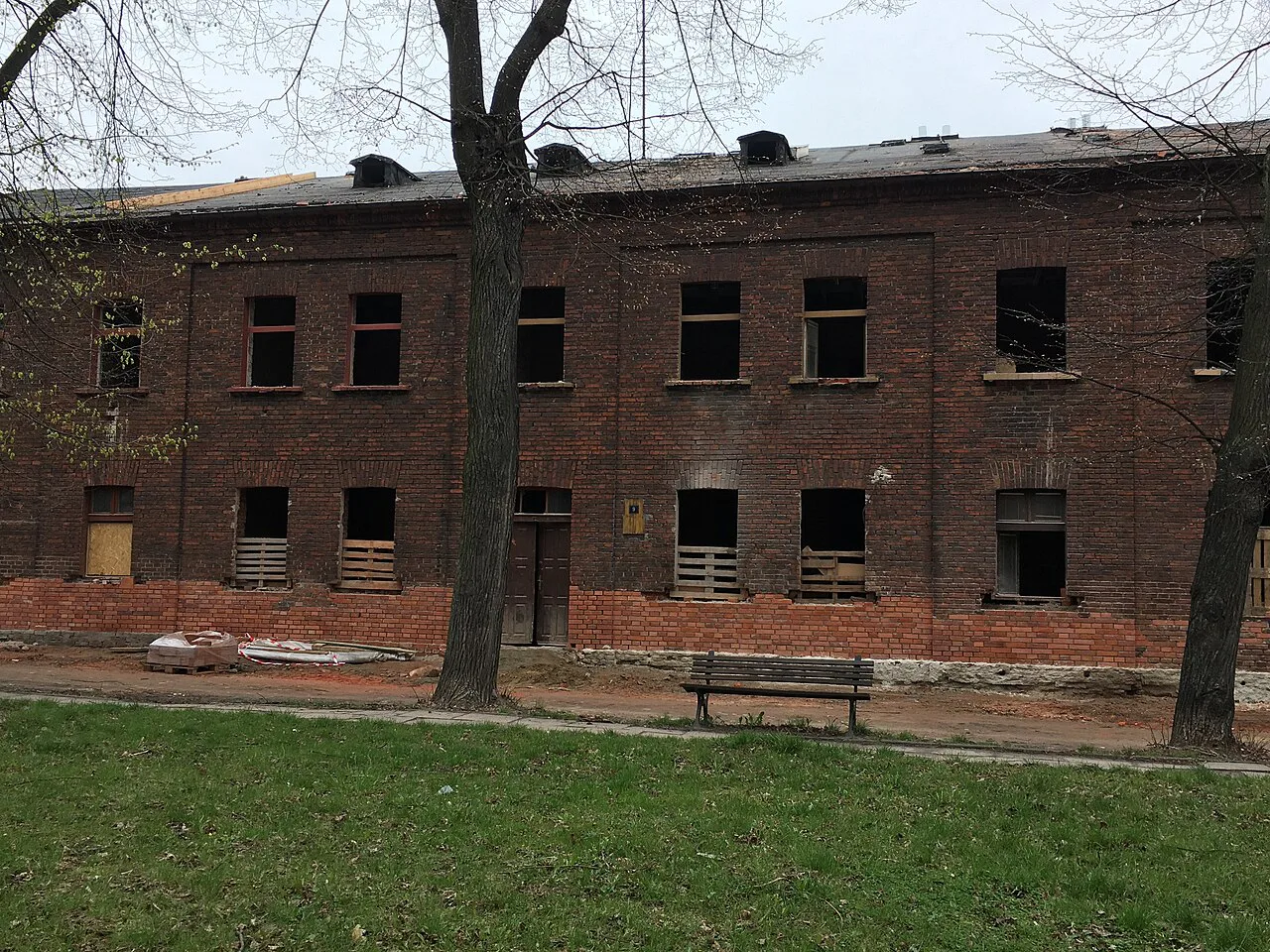
Start with the modest house at Przędzalniana 71, once home to the Wendisch enterprise and the district's earliest industrial chapter. Wendisch arrived from Saxony in 1824 at Rembieliński's invitation, built his mechanical spinning mill and had hydraulic machinery running on the Jasień by 1827. It is an exterior stop rather than an interior visit, so allow a few minutes rather than an hour.
The Marek Edelman Dialogue Center on Wojska Polskiego 83
The Marek Edelman Dialogue Center at Wojska Polskiego 83 is the one indoor stop in the district and the natural end point of a walk. It holds exhibitions and is also the starting point for engaging with the history of the Łódź ghetto, the German Nazi Litzmannstadt-Getto, in a factual and sober setting. Individual visitors pay nothing to enter the building or its exhibitions.
Organised groups of more than ten pay PLN 5 per person for use of the space, and booked guided tours cost PLN 150 in Polish or PLN 250 in English. Tours are arranged in advance through the centre's office email. For a solo traveller or a couple, the free individual entry is the relevant rule.
Opening hours and the free admission rule
The building opens Monday to Friday from 11:00 to 18:00 and at weekends from 12:00, and admission is free for individual visitors, with last entry to the exhibitions half an hour before closing. Hours can shift with the season, so check the centre's own page before you set out. The office is open Monday to Friday only, which matters if you want to arrange a tour.
The first-floor closure and what is closed
Part of the centre is currently off limits: the first floor, which holds the Elementarz Empatii (Primer of Empathy) exhibition and the exhibition dedicated to Marek Edelman, is closed to visitors while the space is rearranged. The building's other current exhibitions remain open during opening hours. Go expecting a partial visit rather than the full display, and ask at reception what is showing on the day.
Reading the workers' housing and the Jasień river
The housing rows are the heart of the district, and the pleasure is in the detail: repeated brick façades, deep window reveals and gateways built for a workforce rather than for display. Walk along a couple of parallel streets rather than only the main road, and look at how the Jasień slips between the plots. The Survivors' Park is part of the Dialogue Center's site, giving a green pause at the end of the loop.
Who the district suits and who it does not
Księży Młyn suits travellers who like industrial architecture, social history and walking a neighbourhood without a fixed route. It is less rewarding if you want a single blockbuster sight with a ticket, a café at every corner or a guaranteed indoor stop for a rainy afternoon. The free Dialogue Center softens that trade-off, but it is one building rather than a museum quarter, and the pick between the two rests on how much brick and river walking you enjoy.
Where to eat near Księży Młyn
The district is residential and industrial in character, so plan eating around the wider city rather than a specific table in the mill streets; the nearby neighbourhoods and the centre carry the densest choice. Check menus and hours on the day, since independent kitchens change their schedules. If you want a long lunch inside the loop, build it in before you start walking rather than hoping to find it mid-street.
Staying in the area versus elsewhere in Łódź
Most visitors stay elsewhere in Łódź and come to Księży Młyn for a half-day. Śródmieście, Łódź gives you more restaurants, evening choice and transport connections within walking distance of the centre. Treat the district as a daytime excursion rather than a base, and you will plan a better trip.
Bałuty, Łódź, on the other side of central Łódź, is a different industrial and residential story that pairs well with a longer stay. Reading the two districts against each other sharpens what makes Księży Młyn distinctive.
Widzew, Łódź, lies east of the mill colony and gives another angle on the city's industrial geography if you have a spare afternoon. Polesie, Łódź, west of the centre, appeals for its parks and quieter residential streets. Both are worth a look once the essential stops are ticked off.
How much time to allow and how to combine it with the rest of Łódź
Allow two to three hours in Księży Młyn: a slow loop through the housing streets and along the Jasień, plus the exhibitions at the Dialogue Center. Arrive by tram or bus, walk the district, and finish at Wojska Polskiego 83 so you are near transport when you are done. Pair it with a city-centre afternoon rather than another industrial district, so the day does not blur into brick.
Is Księży Młyn worth half a day?
Yes, if you want to walk through a nineteenth-century factory colony rather than queue for one sight. The free exhibitions at the Dialogue Center give the walk context, and the housing streets and Jasień river do the rest. Plan the loop for a daytime slot and leave the evening to central Łódź.
Explore more Łódź guides
Frequently Asked Questions
Do I need a ticket for Księży Młyn?
No ticket is needed to walk the district's streets. The Marek Edelman Dialogue Center is also free for individual visitors, though booked guided tours for organised groups carry a charge and must be arranged with the centre in advance.