
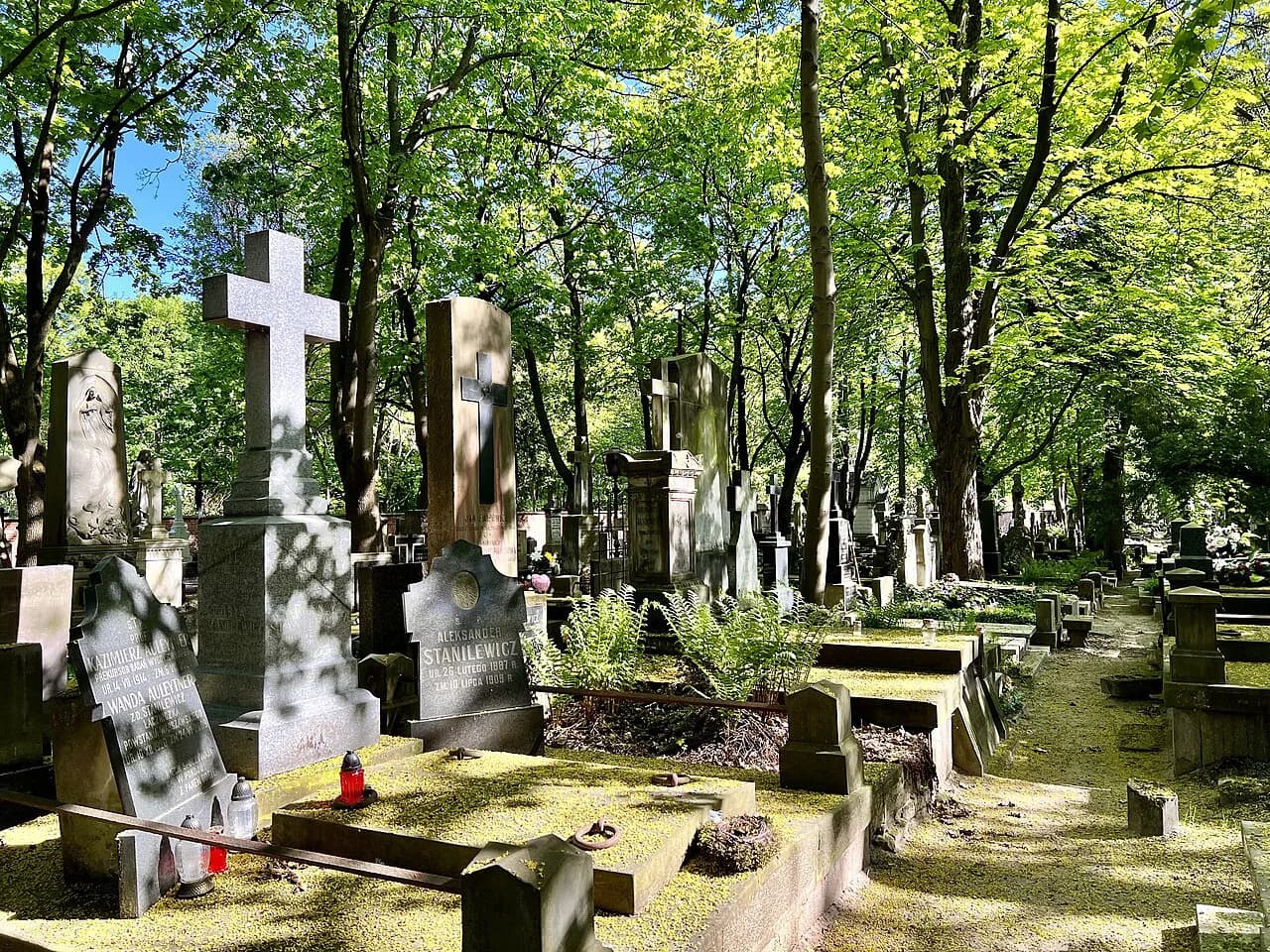
Powązki Cemetery: Visiting Warsaw's Historic Stare Powązki

Give Stare Powązki two hours if you want the catacombs, the Avenue of the Meritorious and a handful of named graves; a focused grave visit takes under an hour. The cemetery covers 43 hectares in the Wola district and holds more than a million burials, so the first decision is whether you are coming to pay respects or to read the place as an open-air museum of Polish sculpture. This page covers the layout, the gate times, the standout monuments and the practical business of finding one stone among tens of thousands.
Stare Powązki in brief
Powązki Cemetery was founded in 1790 on land given by the Szymanowski family, and its consecration followed on 20 May 1792 with the king present. It began at 2.6 hectares and has been enlarged repeatedly to reach 43 hectares, now laid out in sections, rows and plots divided by tree-lined paths that give the grounds their reputation as a green pocket of Warsaw. The present-day site mixes that park-like calm with dense, carved funerary art.
More than a million people are buried here, a roll that includes actors, painters, scientists, professors, clergy, writers and military figures. That breadth is what makes the cemetery worth a detour even for travellers with no family connection: it is a compressed record of two centuries of Polish public life, read through names, dates and the changing style of tomb design.

Where it is and how to get there
The cemetery sits in Wola, bounded by Okopowa, Powązkowska, Tatarska and Jana Ostroroga streets, and you can enter from any side. Because the grounds are a walled block rather than a single-fronted site, it pays to check which entrance is nearest your destination before setting off: a grave in the far quarter can be a fifteen-minute walk from the wrong gate.
Drivers can park on the surrounding streets or at Arkadia Shopping Centre, a few minutes' walk away. Treat Arkadia as a practical landmark for orientation as much as a car park, and note that the parish office address of 14 Powązkowska Street is an office, not the main visitor entrance.

Opening hours: gates, office and seasons
Gate times follow a seasonal pattern rather than one fixed daily closing: the gates are open 7:00 AM to 8:00 PM in the summer season and 7:00 AM to 6:00 PM in the winter season. A winter visit therefore ends a couple of hours earlier than a summer one, so plan a late-afternoon walk accordingly and check the current dates of each season on the official site before you go.
The cemetery office runs Monday to Friday, 8:00 AM to 3:00 PM, which is a working office window and not a visiting slot. The parish office at 14 Powązkowska Street opens by prior telephone appointment on weekday mornings and after 6:00 PM. If your trip hinges on an administrative question, plan it for a weekday morning rather than a weekend.
What to see: chapels, catacombs and the Avenue of the Meritorious
Start with the church of St Charles Borromeo, designed by Dominik Merlini, and the catacombs built alongside it in the cemetery's earliest years. This is the historic core, where architecture and burial space sit together, and it gives a first visit a natural anchor before you wander into the sections.
The Avenue of the Meritorious is the other headline: a single line of graves that functions as a national roll-call, with Władysław Reymont, Jan Parandowski, Leopold Staff, Czesław Niemen and Jan Kiepura among those buried along it. Walk it slowly rather than treating it as a checklist, because the surrounding plots carry equally fine sculpture with far fewer visitors standing in front of them.
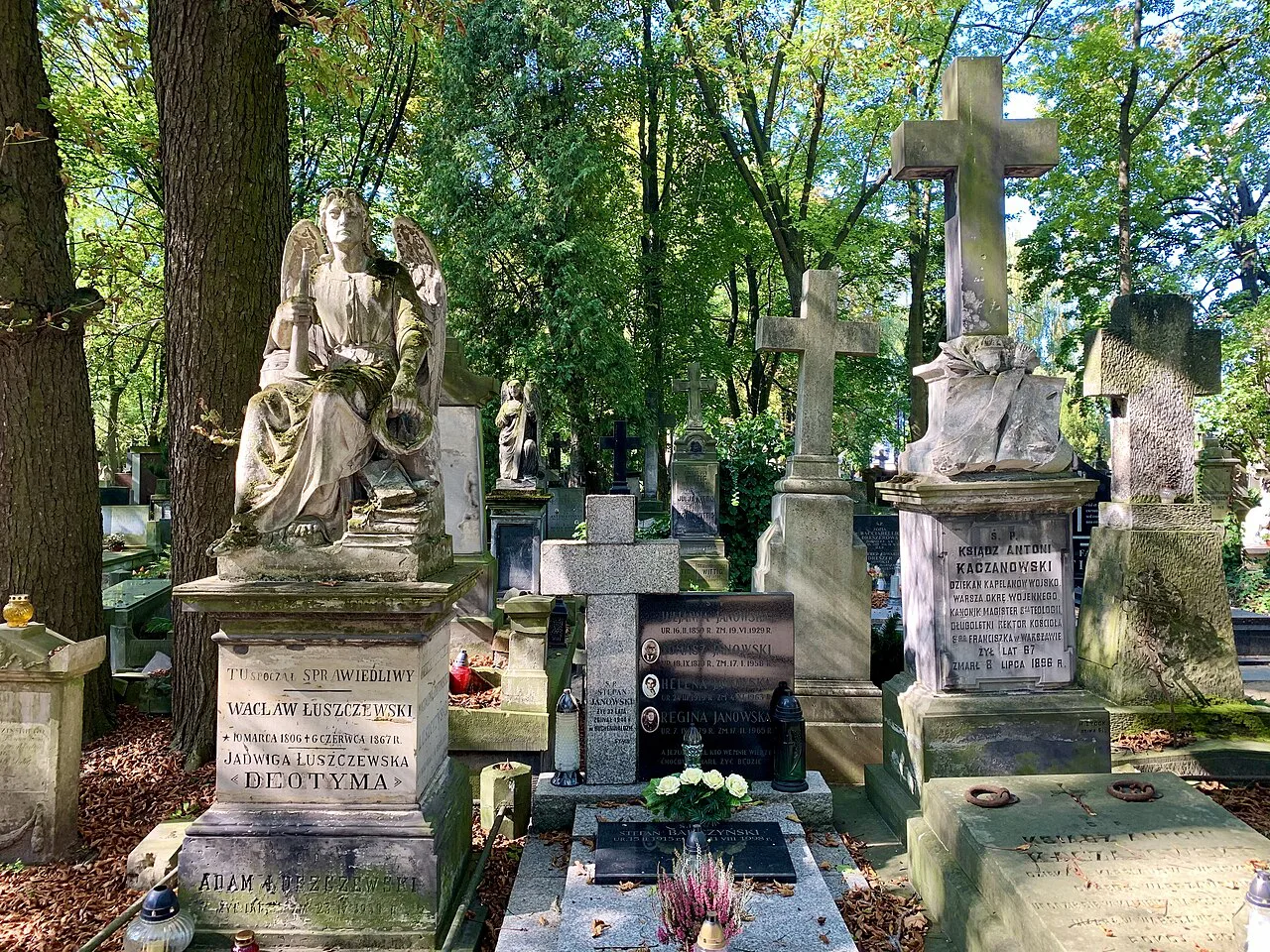
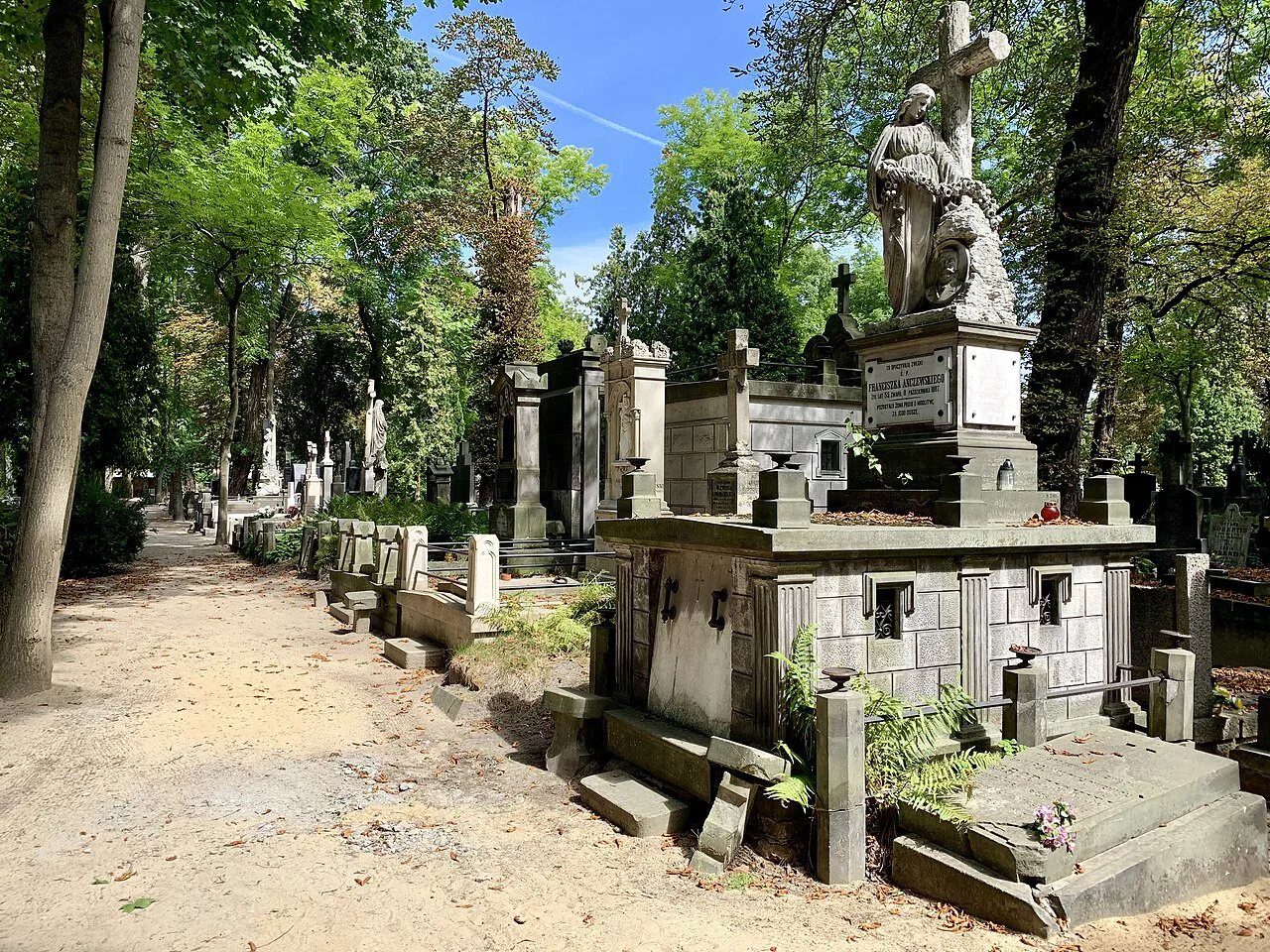
Beyond the famous names, the cemetery is a survey of funerary art across two centuries, from modest family stones to elaborate chapels and figure sculpture. The paths between sections are lined with mature trees, which is why the grounds are described as the green lungs of Warsaw and why a summer visit feels more like a park walk than a monument tour.
The Second World War left its mark here: around 20% of gravestones were destroyed, the church was damaged and the cemetery archives burned during the Warsaw Uprising. Tombs were used as shelters and weapons stores, and in 1944 the grounds became an escape route for prisoners from Pawiak Prison during the operation of that name. Knowing this changes how you read the repaired stones and the gaps between them.
Graves of notable figures
A short list worth planning around: Reymont, Staff, Niemen and Kiepura on the Avenue; the parents of Frédéric Chopin; poet Zbigniew Herbert; composer Witold Lutosławski; film director Krzysztof Kieślowski; Second World War courier Jan Nowak-Jeziorański; and Irena Sendler, honoured as Righteous Among the Nations for saving 2,500 Jewish children from extermination. The cemetery's own account gives these names and that figure for Sendler, and its tone is commemorative rather than dramatic.
Stefan Starzyński, Warsaw's mayor at the time of the German invasion, has a grave here although his body was never recovered after his detention by the Gestapo; Home Army soldiers killed in the Warsaw Uprising occupy large areas of the grounds. Approaching these as memorials rather than sights is the right register, and it is worth pausing before photographing mourners or active graves.
Finding a specific grave before you arrive
Graves are located by quarter, row and place, so the useful preparation is to look up the record first and arrive with those three references written down. The cemetery runs an online grave search that returns a grave's location and a short biography, and visitors can submit corrections or fresh photographs to keep the records current. Do this at home rather than at the gate, where navigation by section numbers is slow.
Expect the search to give you a plot reference, not a coloured dot on a map. Once inside, match the quarter number on the path signs to your note, then count rows, and allow extra time on a first attempt: the same surname appearing on several stones in one quarter is common.
Guided walks versus exploring on your own
The cemetery organises themed guided walks, with more than 50 topics to choose from, and also offers free guided lessons for primary and secondary school groups. Individual visitors can either join one of those themed walks or simply wander the paths at their own pace. Themed tours suit travellers who want the life stories behind the stones; solo walking suits anyone who prefers to linger.
Book through the cemetery's own visit pages rather than assuming a walk runs on the day you arrive, because topics and dates vary. If you are travelling as a family or school group, the free lesson offer is the obvious route in, but it needs arranging in advance.
How long to allow and when to come
Budget 90 minutes to two hours for a first visit combining the church and catacombs, the Avenue of the Meritorious and a handful of named graves; add an hour if you are searching for a family plot without a confirmed reference. The site is large enough that crossing it twice is tiring, so group what you want to see by quarter.
Early morning and the last hour before the gates close are the quietest windows, and weekday visits avoid the weekend crowds that gather around the famous names. In the winter season the gates close at 6:00 PM, so late afternoon in the colder months leaves little margin.
Etiquette at a working cemetery
This is an active burial ground: funeral Masses are held at the parish church on weekday mornings, and the gates stay open to mourners as well as visitors. Keep voices low near services, give way to funeral processions and avoid photographing grieving families. Dress as you would for a church visit, and treat the graves themselves as private memorials.
Nearby in Wola after your visit
The cemetery sits in a district with more to see, so it works well as one half of a day rather than a whole outing. The Palace of Culture and Science, Warsaw's most recognisable landmark, is a reasonable next stop, and the broader set of Warsaw Attractions: 10 Visitor Guides will help you sequence the rest of the day around Wola and the centre.
Arkadia Shopping Centre, a few minutes' walk from the cemetery, is the practical stop for a coffee or a warm-up after a cold walk through the grounds. Beyond that, plan your next move with a wider list of things to do in Warsaw, since Wola connects easily to the historic centre.
Is Stare Powązki worth part of your Warsaw day?
Yes, if you want Polish history told through names and stone rather than exhibition cases. Two hours covers the catacombs, the Avenue of the Meritorious and a few graves; come on a weekday morning if you want quiet, and note that the gates close at 6:00 PM in the winter season.
If you are tracing a particular grave, look up the quarter, row and place online first, write it down and bring it with you. That single step turns a frustrating wander in 43 hectares into a short, purposeful walk.
Explore more Warsaw guides
Frequently Asked Questions
How do you find out where someone is buried in Powązki Cemetery?
Use the cemetery's online grave search, which returns the quarter, row and place of a grave along with biographical notes. Write the three references down and match them to the section signs inside the grounds; allow extra time on a first attempt.
Is Stare Powązki free to visit?
No admission price is listed for entering the cemetery, and the gates are open to the public during the published seasonal hours of 7:00 AM to 8:00 PM in summer and 7:00 AM to 6:00 PM in winter. Guided themed walks and group lessons are arranged separately through the cemetery's own booking pages.
How long does a visit to Powązki Cemetery take?
Allow 90 minutes to two hours for the church and catacombs, the Avenue of the Meritorious and a few named graves. Add an hour if you are hunting a family plot without a confirmed quarter and row reference.
Can you park near Powązki Cemetery?
Yes. Parking is available on the streets surrounding the cemetery, and Arkadia Shopping Centre nearby offers parking a few minutes' walk from the grounds.