Best Time to Visit Warsaw: Month-by-Month Weather and Crowds
The best time to visit Warsaw is May to September for warm walking weather, with August the warmest month. Compare typical temperatures, rain and humidity by month.
On this page
The best time to visit Warsaw is May to September, when typical daytime highs run from 19°C to 24°C and outdoor sightseeing is comfortable. August is the warmest month, with an average maximum of 24°C, while May is the least humid at around 69%. This guide works through the year month by month, pairs each season with the kind of Warsaw day it suits, and treats every figure as a historic average rather than a forecast.
The short answer: May to September for outdoor sightseeing
If your trip is built around walking the Old Town, the Royal Route and the Vistula embankments, aim for May to September. Warsaw's historic climate averages put daytime highs at 19°C in May, 22°C in June, 24°C in July and 24°C in August, then 18°C in September, which is comfortable for a full day on foot without the heat of a southern European city.
The trade-off is rain. July is the wettest month in the historic record at around 102 mm across roughly 20 rainy days, and August is close behind at 98 mm, so a summer trip needs indoor options rather than a different month. Warsaw's museums, reconstructed Old Town streets and covered passages absorb a wet afternoon without wrecking the itinerary.
If you want dry, cold streets and short queues more than long daylight, January, November and December have the lowest chance of rain in the same dataset. Those months come with highs of 1°C to 6°C, so the calculation is warmth against wetness rather than a clear win for either.

Warsaw's typical weather month by month
The table below uses historic climate averages for Warsaw, not a forecast for your dates. Treat the numbers as a planning baseline: they tell you what to pack and how to structure a day, not what the sky will do on a given Tuesday.
Average highs climb from 1°C in January and 2°C in February to 7°C in March, 13°C in April and 19°C in May. June reaches 22°C, July and August both 24°C, September 18°C and October 13°C, before November falls to 6°C and December to 2°C. Overnight lows sit a few degrees below freezing in midwinter and around 13°C to 14°C in midsummer.
Rainfall is modest in late autumn and winter, at 20 mm to 34 mm a month from November to February, and heaviest in the warm months: 78 mm in May, 86 mm in June, 102 mm in July, 98 mm in August and 72 mm in September. That pattern is why summer in Warsaw is a rain-plan problem rather than a reason to stay away.
Spring: March to May
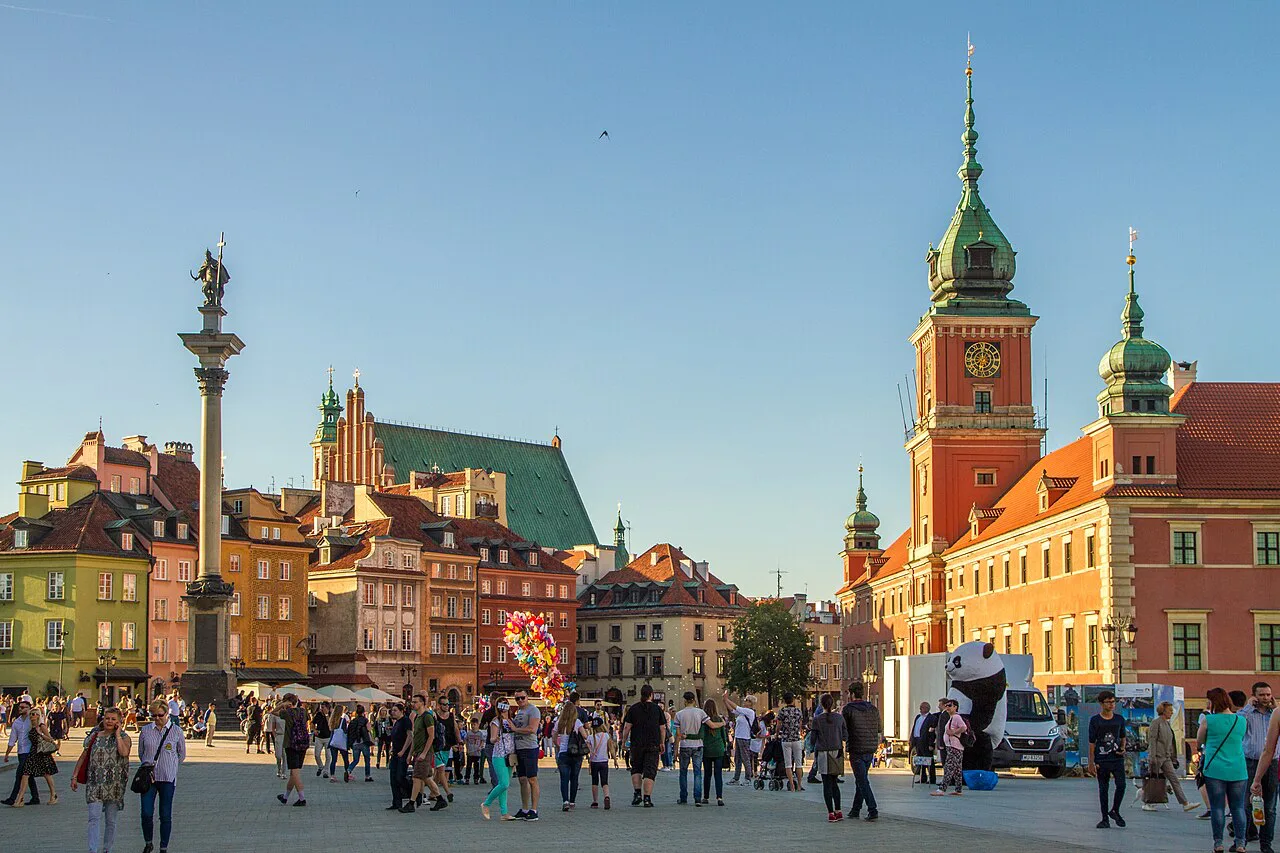
Spring arrives slowly. March averages 7°C by day and minus 1°C at night, April lifts to 13°C and May to 19°C, so late April and May are the months when a coat can stay in the bag for most of the day. May is also the least humid month in the historic record, at around 69%, which makes long walks along the river and through the parks feel easier than in high summer.
Rain rises through the season, from 30 mm in March to 45 mm in April and 78 mm in May, so a spring break should keep one indoor anchor per day. A good pattern is a museum or palace in the morning and an outdoor stretch in the afternoon, which also suits the changeable light of early spring.
April is a sensible compromise for a first trip: milder than March, drier than May and less busy than midsummer. If your dates are fixed in early spring, plan around interiors and short outdoor walks rather than full days on foot.
Summer: June to August
Summer is the warmest stretch and the busiest for outdoor plans, with averages of 22°C in June and 24°C in both July and August. It is also the wettest: roughly 86 mm in June, 102 mm in July and 98 mm in August, spread across about 19, 20 and 18 rainy days respectively. The sensible approach is to keep summer dates and build a wet-weather plan rather than move the trip.
Summer rain can arrive in short heavy spells, so pairing a morning outdoors with an afternoon in a museum gives you a fallback. The rebuilt streets of the Old Town and the riverside paths are the obvious outdoor picks, with the indoor sights held in reserve.
Group summer days by theme: one for the Old Town and Royal Route, one for museums and memorials, one for parks and the river. That structure means a washout costs you an afternoon rather than a whole day, and it keeps a three-day trip from collapsing into a single indoor blur.
Autumn: September and October
September is the quiet sweet spot of the year for many visitors. Average highs of 18°C are still warm enough for a full day outside, rainfall drops to around 72 mm, and the summer crowds have thinned. October cools to 13°C with 47 mm of rain, which still leaves room for outdoor sightseeing in a jacket.
For a trip weighted towards parks and the river, early September is the strongest choice. For museums and architecture, October works well because the days are cooler and indoor time feels like a reward rather than a retreat from the heat.
Autumn dates rarely go wrong on weather alone, so the deciding factor is usually what you want to see rather than the thermometer. Check the venue's own site for dates and opening details before you book.
Winter: November to February
Winter in Warsaw is cold rather than punishing, with average highs of 6°C in November, 1°C in January, 2°C in February and 2°C in December, and overnight lows around minus 4°C in January. Snow is most likely in January, with roughly 11 snowy days in the historic record, though rain is at its lowest ebb in these months.
Days are short and daylight is limited, so a winter city break works best built around museums, memorials, churches and long lunches rather than outdoor walks. A compact two- or three-day trip covering indoor sights is more realistic than a four-day itinerary with a lot of time on foot.
Matching the month to your kind of trip
For museums and architecture, late autumn through early spring keeps you indoors without fighting heat or crowds, and September gives you a comfortable middle ground. For parks, river walks and long days outdoors, May to September is the clear window, with late May and early September offering the best balance of warmth and manageable rain.
For a shorter budget trip, the cooler months of November to March have the lowest rainfall, and outside holiday periods the sights are less busy. Warsaw's main attractions are largely city sights rather than seasonal ones, so the city holds up well outside high summer as long as you plan for cold.
Whatever month you choose, check the venue's own site for opening days before you lock your itinerary. Polish museums commonly close one day a week, and a single closure can reshape a short trip more than the weather does.
Planning a one- to four-day break
For a one- or two-day trip, pick the season that matches your priority rather than chasing perfect weather. If outdoor walking is the point, take May to September and accept a wet afternoon; if you are mainly there for museums, October to April leaves you less exposed to rain and heat.
For three or four days, build a flexible daily structure: one outdoor block, one indoor block and one evening block that can shift. That way a 100 mm July or a cold January snap changes the order of your days rather than the trip itself.
If your dates are tied to a particular period, it helps to know what else is happening in the city, since events can affect how busy the centre feels. Check the city's event calendar before finalising which days go where.
Which month should you book for Warsaw?
Book May to September if the trip is about walking, parks and the river, and pick August only if you want the warmest averages and can plan around rain. Choose late September or October if you want milder temperatures, fewer people and a mix of indoors and outdoors. If you are weighing a Baltic alternative for the same season, the best time to visit Gdańsk follows a similar warmth-versus-rain logic.
If you are going mainly for museums and architecture, November to March is workable provided you dress for 1°C to 6°C days and short daylight, and provided you confirm each venue's opening days before you build the itinerary. For more, see Warsaw in April and Warsaw in summer.
Explore more Warsaw guides
Frequently Asked Questions
What is the weather like in Warsaw in May?
May typically brings an average high of around 19°C and a low of about 9°C, with roughly 78 mm of rain across about 17 rainy days. It is also the least humid month in the historic record, at around 69%, which makes it a strong choice for walking-heavy days.
How cold does Warsaw get in winter?
January is the coldest month, with an average high of about 1°C and a low of around minus 4°C. Snow is most likely in January, with roughly 11 snowy days on average in the historic data, while November and December are milder and February sits around 2°C by day.
Is July a bad time to visit Warsaw because of rain?
July is the wettest month, with around 102 mm of rain over roughly 20 rainy days, but it is also one of the warmest at about 24°C. Keep July dates if they suit you and plan an indoor option for each day rather than moving the trip.
Sources
Notes for your next Polish city break
Optional updates to our Poland guides.
You might also like
Continue reading
More guides you'll find useful