Wrocław Market Square (Rynek): What to See and How to Walk It
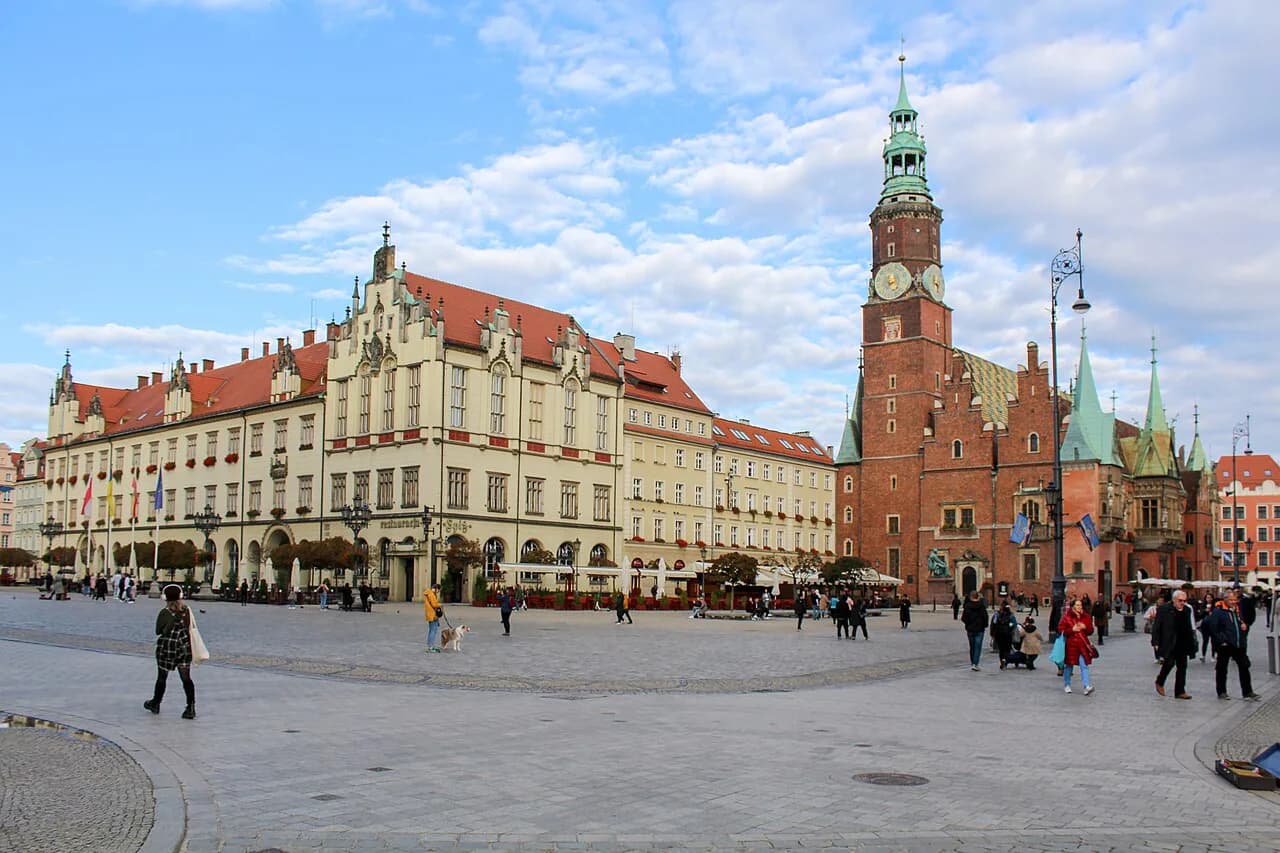
Wrocław's Rynek is a 13th-century square rebuilt after 1945, with a Gothic-Renaissance Town Hall, a central block of painted houses and three narrow alleys.
On this page
Wrocław's Market Square, the Rynek, is worth two to three hours on foot, and it should be the first place you go in the city. It is the main square of the Old Town, laid out in the 13th century and still the same size and shape, and it makes the obvious meeting point before you push out towards Ostrów Tumski. This guide covers what to look at on the square, how the Town Hall and the central block fit together, and a walking order that works from a half-day up to three days.
One thing to settle before you arrive: the Rynek you see is not medieval fabric. The square was almost totally destroyed in the Second World War, and every building around it is a 20th-century reconstruction of its predecessor, rebuilt after the Poles took over the city at the end of the war. That does not make it a film set, but it does change how you read it: you are looking at a careful post-war recreation of a much older street plan.
What the Rynek is and how it is laid out
The square was laid out in the 13th century, after the city was destroyed by Mongol raiders, and it has kept its original footprint ever since. It is described as one of the largest squares in Europe, and the comparison most British travellers reach for is Kraków's Rynek, which it resembles closely in shape and use. Where Wrocław differs is the middle: its central block is much bigger than Kraków's Sukiennice, so the square reads as a ring of buildings wrapped around an inner island of buildings.
The ring around the edge is a mix of townhouses spanning Gothic to Art Nouveau in style, restyled and rebuilt century after century and then reconstructed again after 1945. For a visitor this means you can walk one side of the square and see a different era from the next, which is reason enough to do a full lap rather than one pass. Most of the streets that matter for a short break radiate from the Rynek, so it works as a fixed reference point for the whole city centre.
Use the Rynek as a fixed reference point for the whole city centre: most of the streets that matter for a short break radiate from it, so you can step off the square, explore, and find your way back without a map.
The Town Hall: Gothic and Renaissance in one building
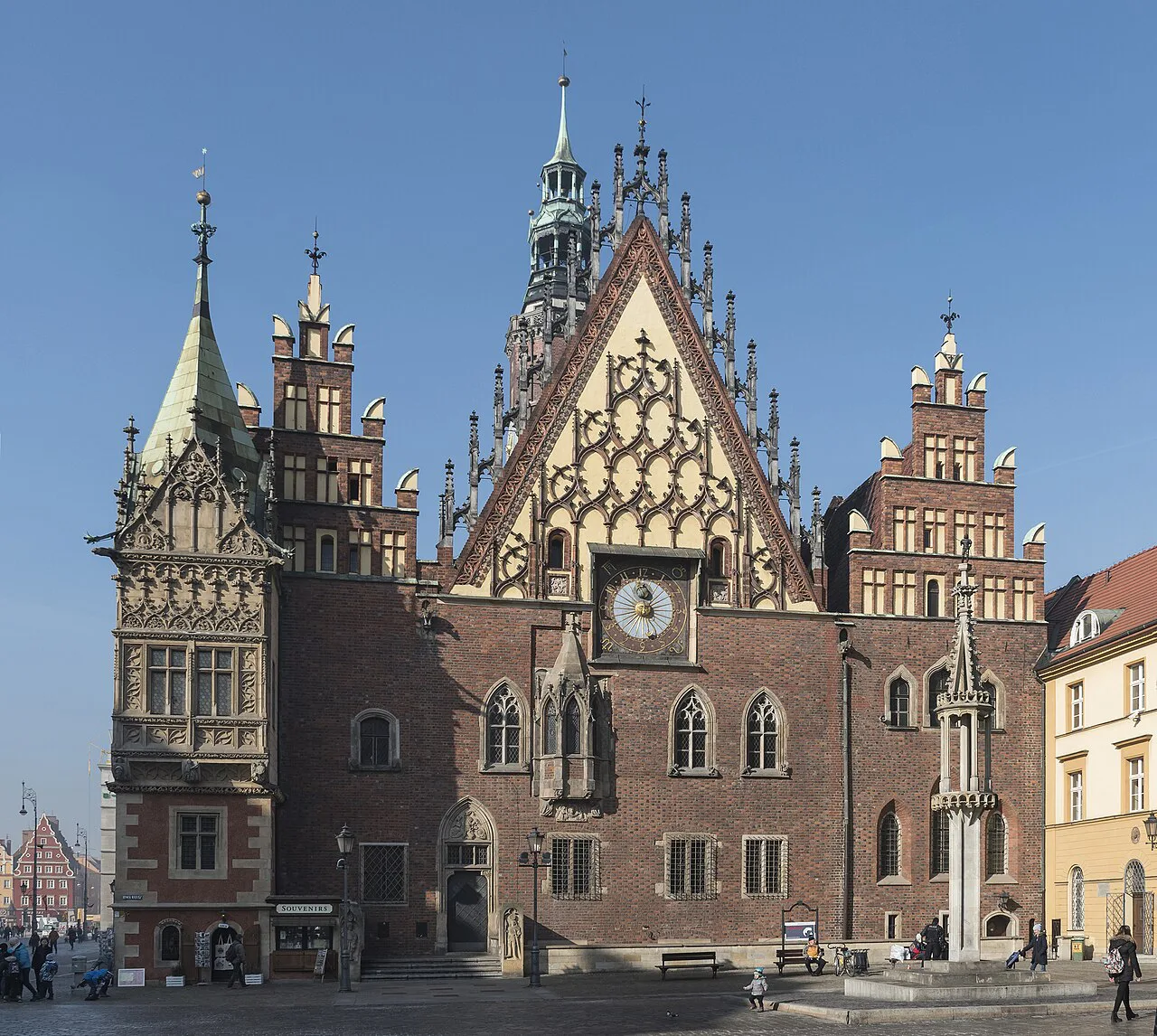
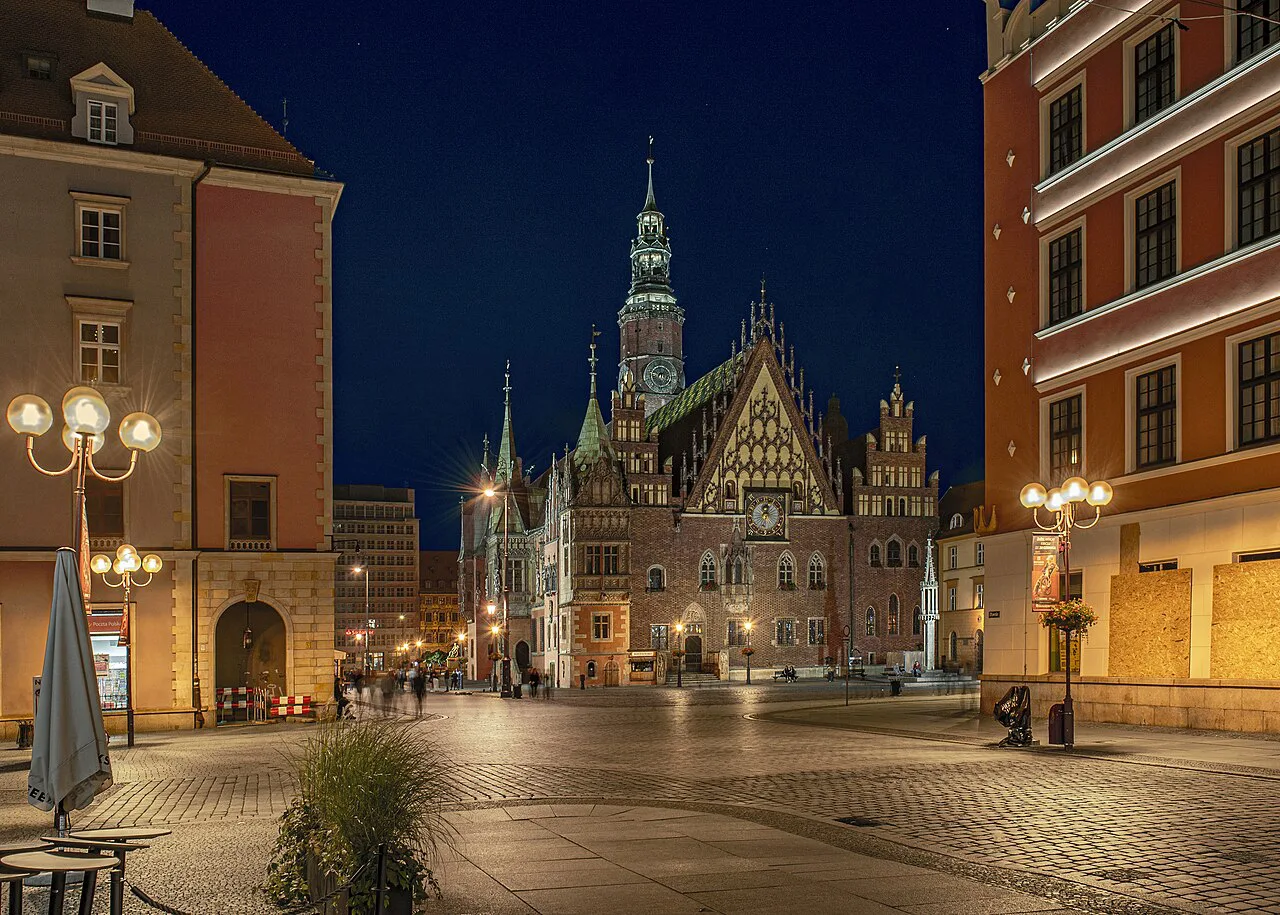
The Old Town Hall is the square's centrepiece and the one building to slow down for. Construction began in the 13th century and continued with extensive alterations into the 16th, so the finished building blends Gothic structure with Renaissance detail rather than belonging to a single style. It also carries its own astronomical clock, which is an easy detail to miss if you keep your eyes at street level.
Treat the Town Hall as the anchor of your first hour: look at it from the open square, then walk round its sides to see how the brickwork and stonework change. The building is a reason to cross the Rynek properly rather than photograph it from one corner, and it sets the architectural tone for the streets beyond.
The central block: painted townhouses and three alleys
The block in the middle of the square is where Wrocław parts company with Kraków. Once a trading area for stalls, it is now four rows of brightly painted buildings cut by three narrow alleys, so you get a warren of passages in the middle of open space. Walk all three alleys: they are short, they connect different sides of the square, and they are where the small shops and upmarket restaurants hide.
Inside the passages you will find jewellery shops, restaurants and bars, including Zorba, described as a laid-back artsy spot. For a break from sightseeing this is the most useful part of the square: it is sheltered, central and lets you eat without leaving the Rynek.
The pillory, the Fredro statue and the bear fountain
Beside the Town Hall stands an elegant stone monument known as a pillory, now a popular meeting point for young Wrocławians. Its original job was punishment: petty criminals were flogged and humiliated here in public, and the practice continued into the 18th century. A local account names the sculptor Veit Stoss, known in Polish as Wit Stwosz, as one of those sentenced here, but treat the story as tradition rather than established fact.
Look also for the seated statue of Alexander Fredro, one of Poland's great comic playwrights. The statue on the Rynek replaced a sculpture of King Frederick II that stood there before the war, and Fredro's memorial now serves as another of the square's meeting points. Nearby is a replica of E. M. Geyger's fountain with a bronze bear; tradition says you touch the bear's nose for luck.
The Feniks department store completes the set of landmarks, once the largest in the city and an Art Nouveau facade worth looking up at. Its glass globe was destroyed by lightning in the 1930s and has not been replaced.
How the Rynek fits the wider Old Town
The Rynek is the hub, and the streets around it are the spokes that lead you out towards the rest of the Old Town. Because the square is ringed with colour and streets open off every side, it is the easiest place in the city to orient yourself: pick a side, follow a street away from it, then come back. That is how the centre is best used rather than treating the Rynek as a single stop on a checklist.
Ostrów Tumski, the cathedral island, is the natural continuation of a Rynek-led walk. Give the square its own time, then save the crossing to the island for when you have had enough of reconstructed townhouses and want the older religious core.
A walking order for the Old Town
Start on the Rynek early, before the square fills up, and do the Town Hall first while you still have attention for detail. Then walk the full ring of the square, then all three alleys in the central block, then the pillory, the Fredro statue, the bear and the Feniks facade. That sequence takes you round once without doubling back and leaves you on the edge of the square ready to head out.
From the Rynek, follow one of the streets away from the square and work outward rather than criss-crossing the centre. Aim to finish at Ostrów Tumski or at the river, so the day has a clear shape: square first, then the streets, then the island. If you only have an afternoon, do the Town Hall, the alleys and one outward walk and leave the rest.
For a second day, come back to the Rynek rather than starting somewhere else, because it is the most useful meeting point in the city and the quickest place to eat or regroup. A Wrocław food stop near the square is easy to fold into the middle of a day rather than a separate outing.
Where the square sits in a one- to three-day plan
For a one-day visit, the Rynek is the morning: Town Hall, the ring, the central alleys, then one walk outward. For two days, give the square a deeper pass on day one and use it as your starting point again on day two before heading to Ostrów Tumski and the river. For three days, the Rynek becomes the place you pass through several times rather than a single sight.
Beyond the photo, the square earns its place as the place where the city is used rather than looked at: people shop, dine, do business and meet here throughout the day. It is also a sensible base for a rainy hour, since the alleys in the central block give you shelter and somewhere to eat without leaving the Old Town.
If you want to see more of the city's green and university side, Ostrów Tumski and the streets around the cathedral are a short walk from the centre and pair well with a Rynek morning. Budget your energy for the square first; the rest of Wrocław can follow.
Is the Rynek worth a full morning, or just a photo?
Give the Rynek a full morning, not twenty minutes. The square rewards a slow lap: the Town Hall is worth time in its own right, and the painted central alleys, the pillory, the Fredro statue, the bear fountain and the Feniks facade all sit within a few minutes of each other. Knowing that the buildings are post-war reconstructions stops the visit feeling like a disappointment and turns it into a lesson in how a city puts itself back together.
Then leave. The Rynek is the start of the Old Town, not the whole of it, and the walk out towards Ostrów Tumski is what turns a square into a day. Plan the square for the morning of your first day and keep a second morning for the streets and the island beyond.
Explore more Wrocław guides
Frequently Asked Questions
What should I not miss in Wrocław?
On the square itself, the Old Town Hall, the three alleys through the painted central block, the pillory, the Fredro statue and the bear fountain. Beyond the Rynek, Ostrów Tumski is the obvious next stop, and it follows naturally from a walk that starts on the square.
Sources
Notes for your next Polish city break
Optional updates to our Poland guides.
You might also like
Continue reading
More guides you'll find useful