Wrocław Street Art: Where to Find Murals and Courtyard Art
Wrocław street art is scattered across the city and shifts as buildings come down. Here is where to look, from Nadodrze courtyards to murals near the Oder.
On this page
Wrocław street art is scattered, moves with the city's building sites, and often hides behind facades in courtyards and passages rather than sitting on main streets. The most distinctive set-piece is Nadodrze, the run-down neighbourhood north of the centre where community-painted courtyards carry three-dimensional artwork you will not find elsewhere in Poland. This guide groups the works by area so you can build a walk instead of chasing individual addresses, and it is honest about what has been lost to demolition.
What Wrocław street art is actually like
Expect variety and churn rather than a tidy open-air gallery. Works cluster around Most Grunwaldzki, spread along the Oder and northeast of the centre, and reward anyone willing to look into side streets and behind buildings. The trade-off is that every list is a snapshot: murals go when old buildings come down, so treat addresses as starting points and be prepared to find a blank wall.
Most of what you are looking for sits in public space: the sides of tenements, bridge tunnels, library walls and courtyard facades. That means no tickets and no fixed visiting hours, but it also means you are walking through residential streets, so keep noise down in courtyards and give people their space. If you want a guaranteed indoor art fix on the same trip, the city's museums make a good rainy-day companion.
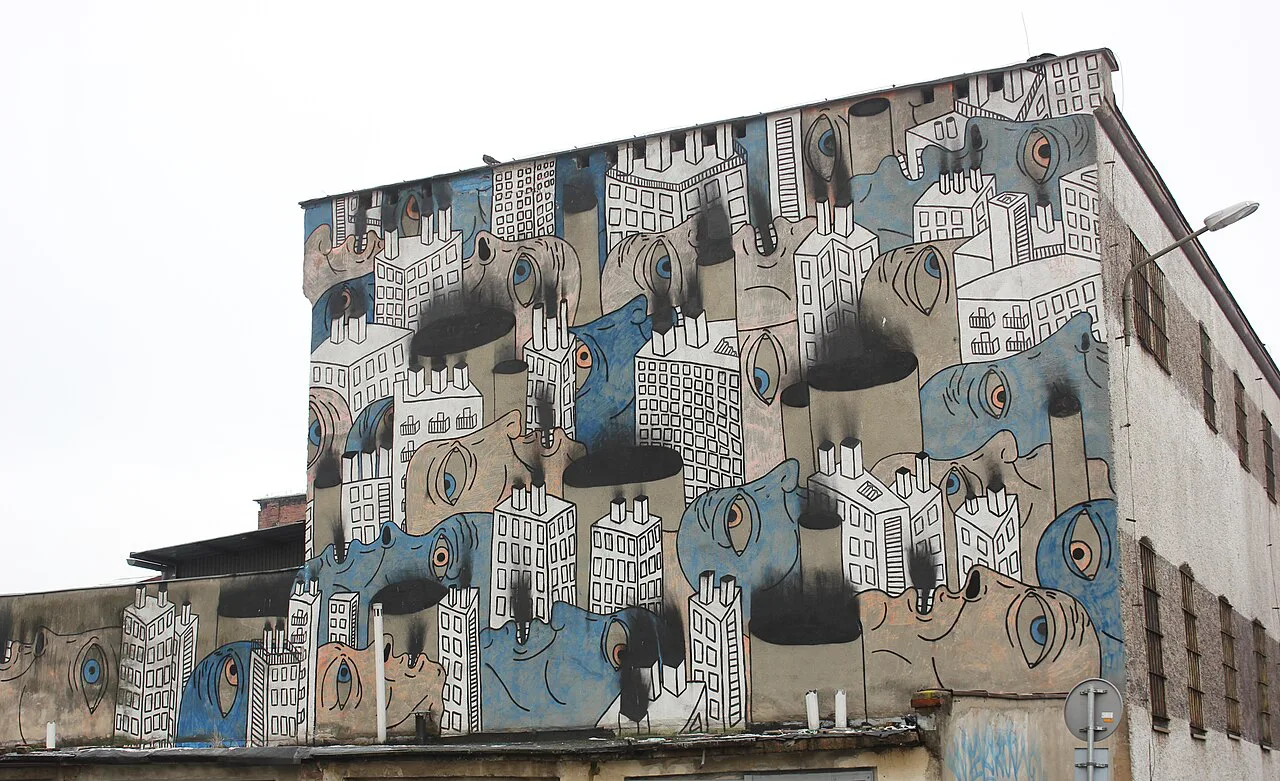
Start at Nadodrze: the painted inner courtyards
Nadodrze lies north of the centre and has kept much of its grim nineteenth-century tenement look, which is exactly why the courtyards surprise people. Behind battered walls, courtyards carry bright, ambitious painting produced with local residents rather than commissioned from outside. Come here first, because it sets the tone for everything else.
The project behind the courtyards is OKAP, the Center for Cultural Backyard Animation, founded in 2014 by the Wrocław artist Mariusz Mikołajek together with other local artists. They ran classes for children and then adults so that residents could develop their own painting and sculptural skills, and the decorated courtyards spread across the neighbourhood from there. Read the art as a community effort, not a street-art festival: the aim was to turn the drab yards into a bright space residents could take pride in.
The un-murals: art that comes out of the wall
Nadodrze's courtyards are known for what the project calls un-murals, because much of the work is three-dimensional. Ceramic figures, household items and other objects protrude from the walls, set among painted scenes, so the effect is closer to walking into a collage than reading a flat mural. Look up and to the sides as you enter each courtyard; the best pieces are often above head height or tucked around a corner.
Because these are working residential courtyards, access depends on the gates being open rather than on signage. Go through open gateways, keep to the middle of the yard, and back out if a door is closed; nobody owes you entry. The reward is art made by untrained adults, seniors and children from the neighbourhood, which is a different experience from the commissioned murals you will see closer to the centre.
Around Most Grunwaldzki: tunnel and plot
Most Grunwaldzki, on the eastern edge of the centre, is the easiest place to start a street-art walk. The pedestrian tunnel on the western side of the bridge is covered in pieces that read almost as one continuous work, and buildings on some vacant ground near the same junction carry two very large murals, including a commercial one. The plot has seen a lot of demolition nearby, so do not count on the buildings staying put.
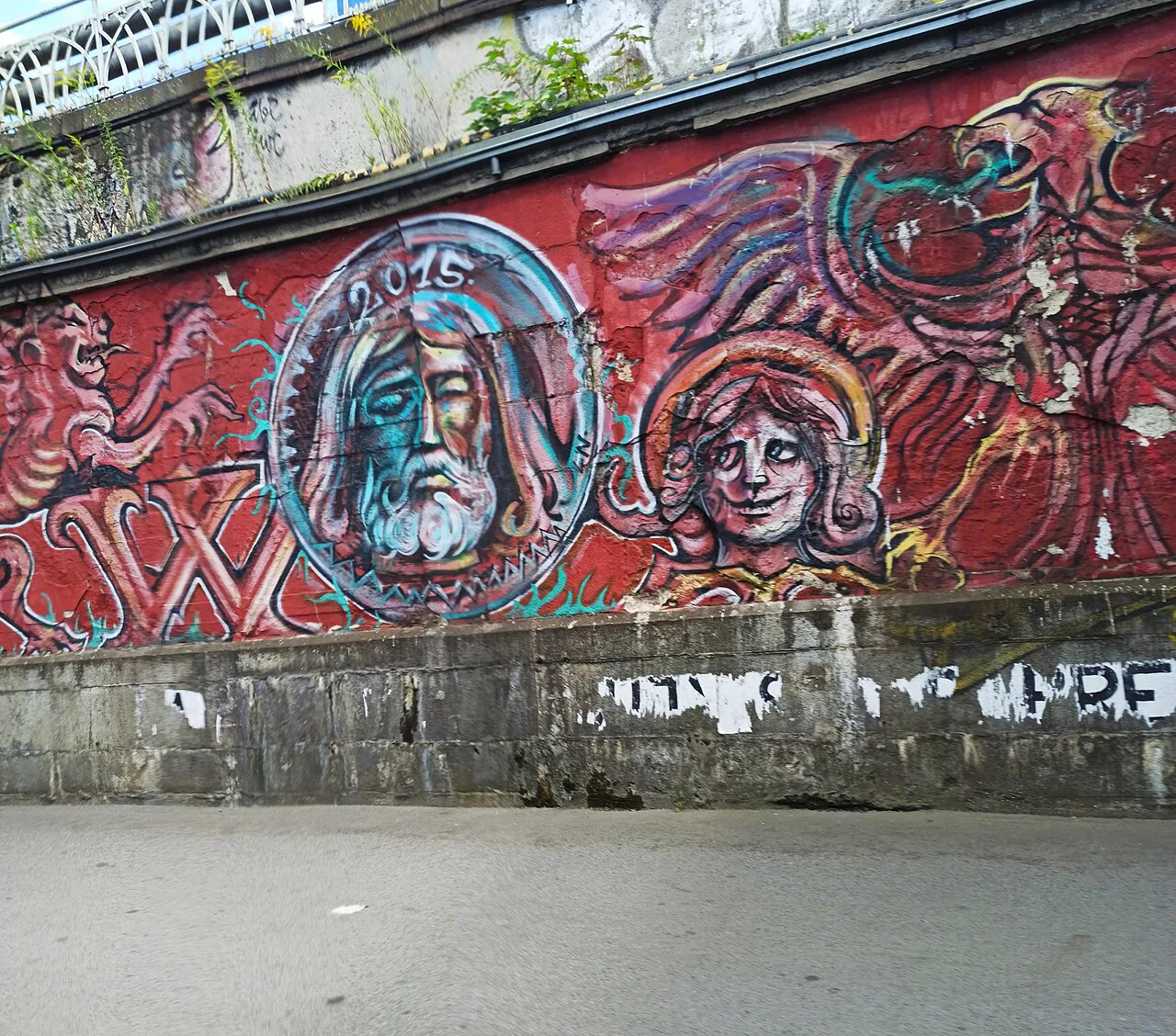
From the bridge it is roughly a ten-minute walk to Wyszyńskiego 5, one of the city's earliest murals, made as part of the MURALIA campaign and competition. This stretch has been thinned by demolition, and Wyszyńskiego 5 now stands fairly alone where several works once clustered. Pair it with the murals on and around Sienkiewicza: one was made for the WrOpenOp campaign promoting openness and equality, and another, about a kilometre away near Mieszka I, was painted for the Brave Festival in 2015 and has faded.
Along the Oder: gateways, libraries and a writer
Head north to the river for a loose cluster of works on both banks. On the corner of Drobnera and Łokietka, the mural that acts as a gateway to Nadodrze was designed by Michał Węgrzyn, a student at the Wrocław Academy of Fine Arts, and won an online vote in January 2013 with 8,615 votes. Around the corner on Łokietka, the library facade is painted with books.
Walk through the passage at the back of that library building and you find more local work, including a large mural of the Polish writer Marek Krajewski. Further west, still close to the Oder, a small side street off Staśnica holds political art linked to the hundredth anniversary of Willy Brandt's birth, much of it overlaid with graffiti.
Wyspa Słodowa, the island in the river, once held a whole collection of street art but has since been rebuilt with new housing and cafés, so little of it remains. Treat the island as a shortcut between banks rather than a destination, and put your time into the north bank instead.
Further out: Eric Il Cane and the festivals
Further along near the Pomorski junction, a mural by Eric Il Cane was made during the first edition of the OUT OF STH project run by the BWA gallery. It is one of the most striking single pieces on this side of the city, with a graphic style closer to the Belgian artist ROA than to the community courtyards. Add it on the way back from the main cluster rather than making a separate trip for it alone.
Beyond the named works, Wrocław has a wider street-art map with addresses scattered across the city, including courtyards and side walls in districts outside the centre. If you have already done the central walk, chasing a few of these makes a good second outing and takes you into neighbourhoods most short-break visitors skip.
How long it takes and how to string it together
A realistic plan is one long half-day on foot. Start at Most Grunwaldzki and its tunnel, walk northeast to Wyszyńskiego 5 and the Sienkiewicza murals, cross toward the Oder for the Drobnera and Łokietka works and the library passage, then finish in the Nadodrze courtyards. Budget three to four hours if you are photographing and looking properly; a determined street-art hunter can easily spend longer.
The walk is flat and mostly on pavements, with the footbridge tunnel as the only enclosed stretch. Break it up with the older parts of the city: the Rynek and the streets around it give you the historic counterpoint, and the Główne Miasto is a short walk from most of the mural sites.
If you are staying two or three days, give the street art one afternoon and keep the rest for the museums and churches. The two halves complement each other: one is official culture with tickets and opening days, the other is free, outdoors and unpredictable.
Why murals disappear
Wrocław is a city of construction sites, and wherever new buildings rise, old ones come down with their murals. This is why works around Wyszyńskiego and on Wyspa Słodowa have thinned out, and why any address you read online may already be gone. New pieces appear too, often from festivals and gallery projects, so the map keeps shifting in both directions.
The practical response is to travel light on expectations. Pick a district and wander it rather than marching between pinned points, and accept that a blank wall is part of the story. The upside is that you end up seeing ordinary Wrocław streets, which is its own reward.
Practical notes before you set out
Write the addresses down before you leave: Most Grunwaldzki, Wyszyńskiego 5, Sienkiewicza, Drobnera at Łokietka, Staśnica, the Pomorski junction and the Nadodrze courtyards. Street numbering in Wrocław is logical but gates into courtyards are not always obvious, so a working offline map helps.
For the city's darker twentieth-century history, which gives context to much of the political art near the Oder, the wartime and post-war sights are worth a separate morning. The Wrocław WW2 material and the Jewish heritage of the city both add depth to a street-art walk that can otherwise feel purely visual.
Is the Nadodrze courtyard walk worth it?
Yes, if you want the one thing Wrocław's street art does better than most Polish cities: community-made courtyards you have to look behind a facade to find. The trade-off is time and uncertainty. The commissioned murals nearer the centre are easier and quicker, but they are also the kind of thing you see in any large city.
Build the walk around Nadodrze and the Oder, add Most Grunwaldzki and the Sienkiewicza works if you have the legs, and treat every other address as a bonus. Check a recent street-art map the week you travel, since buildings come down quickly.
Explore more Wrocław guides
Frequently Asked Questions
Is Wrocław good for street art?
It is, but not in the way a single open-air gallery would be. The art is spread across districts and often hidden in courtyards and passages, with the community-painted courtyards of Nadodrze as the standout. Expect a half-day of walking rather than a short stop.
Do I need a ticket to see the murals?
No. The works described here are on public streets, bridge tunnels, library walls and residential courtyards, so there is nothing to buy. Courtyards are people's homes, so enter quietly and leave if a gate is closed.
How long does a street-art walk in Wrocław take?
Plan on three to four hours for the central loop from Most Grunwaldzki through the Oder bridges and up into Nadodrze. Photographers and anyone hunting the wider street-art map should allow longer.
Sources
Notes for your next Polish city break
Optional updates to our Poland guides.
You might also like
Continue reading
More guides you'll find useful