Socialist Realism Architecture: What It Is and Where to See It in Poland
Socialist realism was the Soviet-imposed style of 1933 to 1955, and Poland's best-known example is Warsaw's Palace of Culture and Science.
On this page
Socialist realism in architecture was a state-imposed doctrine that dressed new buildings in classical and historical forms, and it ran in the Soviet Union from 1933 until 1955. In Poland the single best-known result is Warsaw's Palace of Culture and Science, completed in 1955. This guide explains what the style was, how to recognise it on a street, which Polish examples reward your time, and how to slot one into a one-to-four-day city break.
What socialist realism in architecture actually was
The doctrine took shape in the Soviet Union, where Boris Iofan's draft for the Palace of the Soviets was officially approved in 1933 under Joseph Stalin, and it held until Nikita Khrushchev condemned the "excesses" of the previous decades and disbanded the Soviet Academy of Architecture in 1955. That 1933–1955 span is the anchor for everything else: a Polish building with tiered rooflines and classical ornament most likely dates from the late 1940s or early 1950s, not the 1960s.
The style is also called Socialist Classicism or Stalinist Empire style, and it is tied to the socialist realism school of art. In practice it applied to urban public and residential buildings, sometimes arranged around a square or along an avenue, rather than to the plain mass housing that came later. The form mattered as much as the function: a facade was meant to carry a message, which is why ornament reappears where a purely functional building would have none.
Socialist realism made use of the forms of the past in order to build for the future, a doctrine that carried little concern for present economic reality. That contradiction is the useful thing to hold in mind when you look at these buildings: the classical columns earn their keep as symbolism, not as structure, and the decorative programme often cost more than the budget allowed.
How to recognise it on a street
Look for symmetry first. Socialist realist facades are built around a central axis, with wings stepping down either side and a raised central block or tower holding the composition together. If a building reads as a single balanced statement from across the square, you are probably looking at the 1950s rather than the 1970s.
Then check the roofline, the ground floor and the surface. Tiered, cake-stand silhouettes, arcaded or colonnaded ground floors, and applied ornament such as cornices, pilasters and reliefs are the giveaway. Scale is the fourth clue: these buildings were designed to dominate a square or an avenue, and they still do.
A date test helps more than any checklist. Around 1955 the ornament stops and the concrete starts: blank grids, exposed structure and repetitive prefabricated panels belong to the modernism and brutalism that followed. The break is not perfectly clean across every building, but a facade dense with historical detail is the earlier layer and a flat, repetitive one is the later.
The Palace of Culture and Science in Warsaw
Warsaw's Palace of Culture and Science is Poland's headline example, completed in 1955 and conceived as a "gift from the Soviet people to the Polish Nation". Including the antenna it stands 237 metres (778 feet) tall, which makes it the tallest building in Poland. The designers and builders came from the Soviet Union, yet the architect folded historical Polish styles into the final design, so the building is a hybrid rather than a straight import.
Its original name honoured Joseph Stalin, and the renaming is part of the building's history rather than a footnote. The tower also belongs to a wider family: Moscow's Seven Sisters, built officially from 1947 to 1953, used the same modern construction technology as American skyscrapers while wrapping it in Russian Baroque and Gothic references. Comparable monumental buildings stand in other former communist European cities and beyond the former Soviet Union.
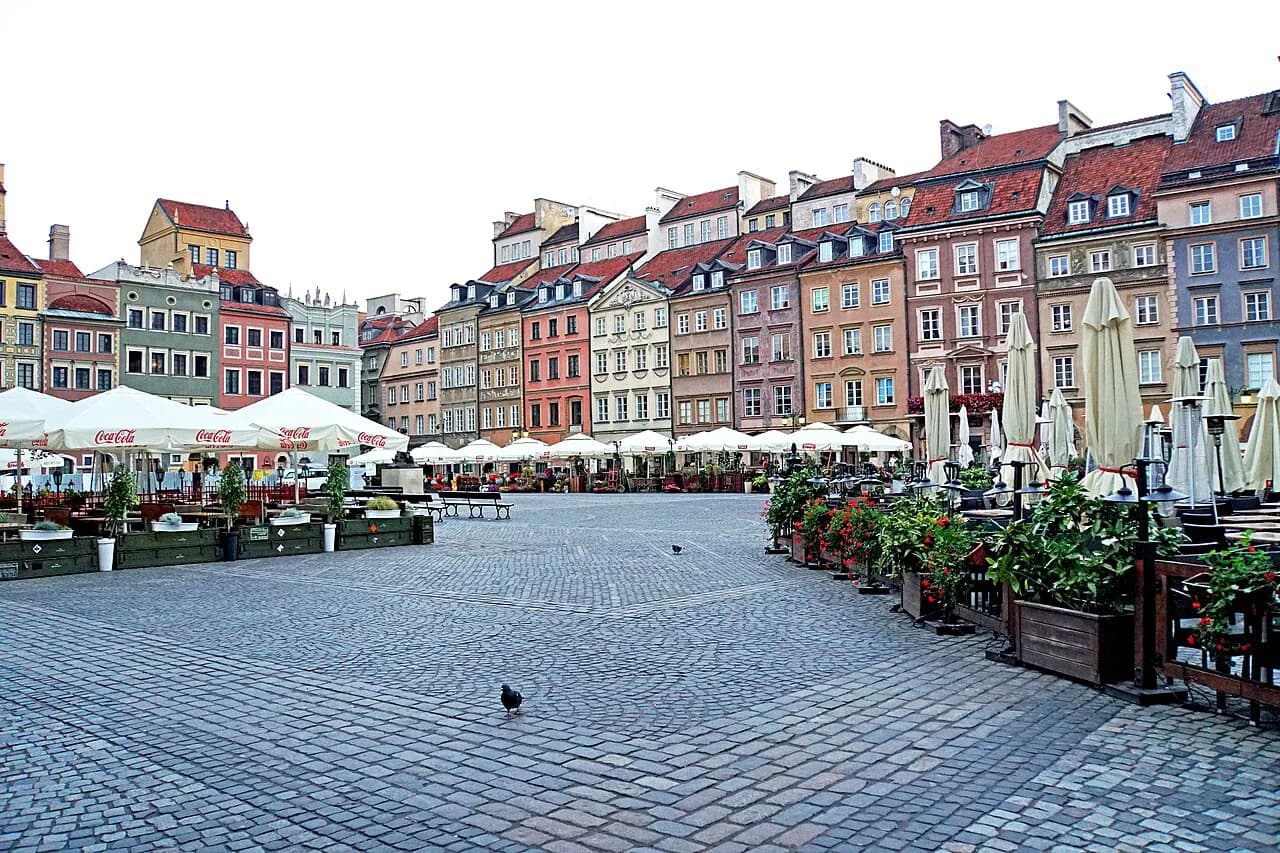
For a city break, the tower works as an orientation point: you see it from much of central Warsaw and it sits among the streets covered in our communist Warsaw material. Pair it with the older core rather than treating it as a standalone stop, because the pleasure is in the contrast between rebuilt Old Town brickwork and 1950s stone. If you want to go inside, check current opening hours and ticketing before you plan your day around it.
MDM: the residential face of the style
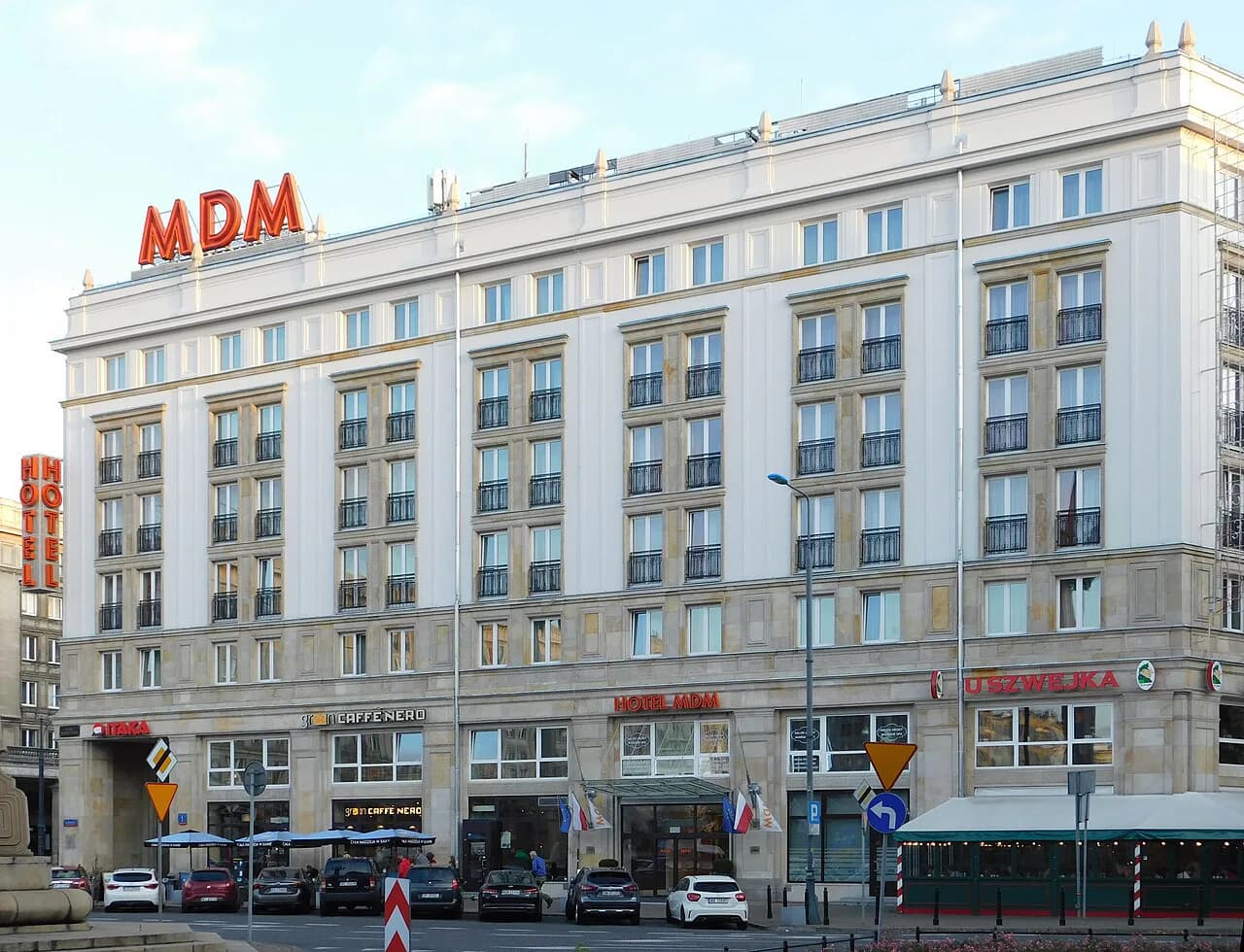
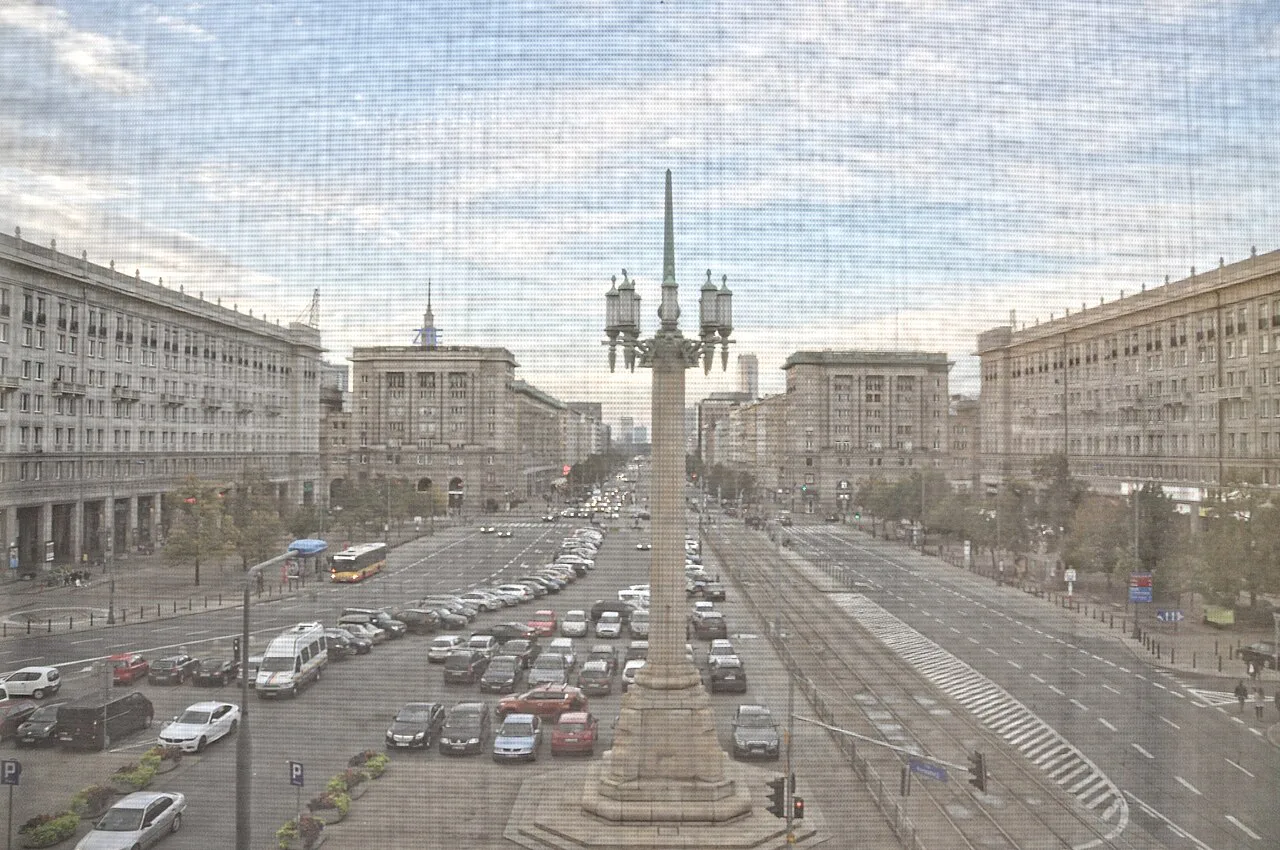
Marszałkowska Dzielnica Mieszkaniowa, usually shortened to MDM, is the residential face of socialist realism in Warsaw: a planned district of housing blocks laid out along a widened Marszałkowska with arcaded ground floors and unified facades. It shows the doctrine at the scale of an everyday neighbourhood rather than a single monument, which is exactly what makes it worth a walk. The buildings were meant to house people and to present a model of city life at the same time.
Read MDM as an ensemble: the street line, the ground-floor arcades, the corner compositions and the consistent height all come from one design intention. The doctrine applied to residential buildings as well as public ones, sometimes set on a square or along an avenue, and MDM is the clearest Polish case of that.
If you want the political and social context alongside the architecture, Warsaw's PRL collections add it. Our guide to the PRL Museum in Warsaw sets out what those sites cover, so you can decide whether to spend an indoor hour or keep to the streets.
Nowa Huta: a planned steelworks town
Nowa Huta, the planned steelworks town outside Kraków, is where the style becomes a whole district rather than a facade. Its layout follows the doctrine's habit of arranging buildings around squares and along avenues, and the result is a place built to a single plan in a short span, which makes the style easier to read than in a city that grew incrementally.
Treat Nowa Huta as a half-day contrast to Kraków's old centre, not a substitute for it. The two are close enough that a morning in one and an afternoon in the other is realistic, and the pairing is the point: medieval walls and market square on one side, 1950s axial planning on the other.
Other Polish cities and how to tell the layers apart
Warsaw is the strongest Polish stop for this style, but the doctrine extended beyond the Soviet Union into many other former communist European cities, and Polish cities outside the capital carry their own 1950s public buildings. Rather than chasing a list, use the date test: ornamented, symmetrical and axial reads as socialist realism, while a blank concrete grid from the 1960s or 1970s reads as the modernism that followed.
The later tradition is worth recognising so you do not mislabel it. Under more authoritarian regimes the monumental approach continued well past 1955, and some elements of Stalinist architecture have resurfaced in recent Moscow buildings, while the socialist modernism of the 1960s to 1980s produced its own distinct heritage of concrete and glass.
Two groups of buildings often get confused. Socialist realism borrowed historical forms to carry a message; brutalism and later modernism stripped the message back to structure and material. If the building looks like it wants to be read as a palace, it is the earlier style; if it looks like it wants to be read as a machine, it is the later one.
What rewards a detour and what does not
The Palace of Culture and Science earns its place on any Warsaw itinerary because it is unavoidable, central and historically loaded, and because the surrounding streets give you MDM in the same afternoon. Nowa Huta earns a half-day if you are in Kraków and want a planned district rather than a single monument.
What you can skip is the hunt for isolated 1950s facades in cities where the older core is the real draw. A single ornamented building seen out of context tells you less than a district seen as a whole, and on a short break the district is the better use of an hour.
Fitting it into a one-to-four-day break
In Warsaw, give the Palace of Culture and Science and MDM one block of time and keep the rest of the day for the Old Town and the museum you came for. In Kraków, use Nowa Huta as the counterweight to the centre. In Gdańsk, the equivalent layer of 20th-century history sits elsewhere, around the Gdańsk shipyard and the Solidarity movement, which is a different story told through different buildings and sites; for the wider picture see our Communist Poland guide.
The general rule is one socialist realist sight per city, paired with the older core on the same day. That keeps the contrast sharp and stops the style becoming a checklist of facades.
Is the Palace of Culture worth half a day?
Yes, for most first-time visitors to Warsaw: it is the country's clearest socialist realist monument, it is central, and the MDM streets around it let you read the style at neighbourhood scale in the same visit. Budget half a day for the tower and the surrounding district, and check current opening and ticketing for the interior before you go.
If your break is shorter than that, look at it from the street and spend the saved time on the older core. If you are in Kraków instead, make Nowa Huta your version of the same trade-off.
Sources
Notes for your next Polish city break
Optional updates to our Poland guides.
You might also like

Continue reading
More guides you'll find useful