
Communist Poland: Where to See the PRL Era on a City Break
Communist Poland explained for visitors: the PRL years from 1947 to 1989, what remains on the ground, and which districts and museums reward a city break.
On this page
Poland is not a communist country today. Communist rule ran from the late 1940s until 1989, when the Polish People's Republic gave way to the Third Republic, as the country's post-war communist state is described in the historical record. This guide covers where that era is still readable on the ground, which cities repay a day of it, and how to fit it into a two- or three-day break without turning the trip into a history lecture.
The short version: Warsaw for the Palace of Culture and the reconstructed Old Town, Nowa Huta for a planned socialist-realist steel town beside Kraków, Gdańsk for the shipyard and the Solidarity story, and Łódź or Poznań for industrial and uprising context. The rest of this page sorts those into museum visits and walking visits, with honest notes on what each one actually gives you.
What 'communist Poland' means in plain terms
The Polish People's Republic, usually shortened to PRL, was the one-party state that governed Poland after the Second World War. It is treated in standard histories as a communist state established after the Red Army took Polish territory from German occupation, and it lasted until the round-table agreements and the 1989 elections ended the monopoly of power.
For a visitor, the useful mental model is that the PRL was not a single frozen decade. It moved from Stalinist reconstruction in the late 1940s and early 1950s, through the Upheavals of 1956 and 1968, to the mass movement of the 1980s. That is why the buildings look so different from one district to the next: a socialist-realist avenue, a 1970s housing estate and a shipyard gate each belong to a different chapter.
Timeline for orientation: German occupation ends in 1945, communist rule is consolidated by the late 1940s, Poznań sees a workers' uprising in 1956, Gdańsk shipyard strikes follow in 1980, and 1989 brings the end of the system. Treat these as fixed markers rather than something to squeeze into one afternoon.
How Poland became communist after the Second World War
Poland emerged from the war with its cities destroyed and its borders shifted westwards, and the communist takeover happened in that vacuum. The Polish Workers' Party absorbed the Polish Socialist Party in 1948 and became the Polish United Workers' Party, which then ran the state, the economy and the security apparatus.
The pattern matters for sightseeing because so much of the rebuilt fabric dates from those years. Warsaw's Old Town is a post-war reconstruction, valued by UNESCO precisely because it was rebuilt after the wartime destruction, and that rebuilding is part of the communist-era story as much as the Palace of Culture is.
Agriculture is the detail that surprises most British and American visitors: unlike the Soviet Union, Poland never fully collectivised its farms, and private smallholdings survived alongside state industry. That mixed economy is one reason the country's communist period felt different from its neighbours'.
What communist rule looked like day to day
The everyday texture was queueing, rationing, state factories and a single official narrative in the press. Housing was allocated rather than bought, and the big estates on the edge of every city were built to that logic: prefabricated blocks, wide roads, green space between them, and shops placed at the nodes where people walked.
For travellers this becomes a practical reading skill. When you walk a PRL-era estate, look for the repetitive stair cores, the blank end walls, the generous gaps between buildings and the separate pedestrian routes; those features tell you the plan was drawn as a system rather than plot by plot.
The 1970s are worth separating out, because that decade brought both consumer borrowing and the workers' protests that eventually fed into Solidarity. If you want one period to anchor a walking day, the 1970s estate plus a 1980s shipyard or memorial is the most legible pairing.
City by city: where to see the era
Warsaw carries the most concentrated set of PRL sights and is the obvious base for a first visit. Nowa Huta, the planned steel town attached to Kraków, is the clearest single piece of socialist-realist urban planning in the country. Gdańsk holds the shipyard and the Solidarity legacy, Łódź the textile-industrial story, and Poznań the 1956 uprising memory.
A workable split is one museum-and-memorial day plus one walking-the-district day per city. Museums give you dates, documents and objects in a controlled setting; districts give you the scale and the street plan, which no exhibition can reproduce. Most people underestimate the second half and overestimate how much of the first they can absorb.
Warsaw: the Palace of Culture and the rebuilt centre
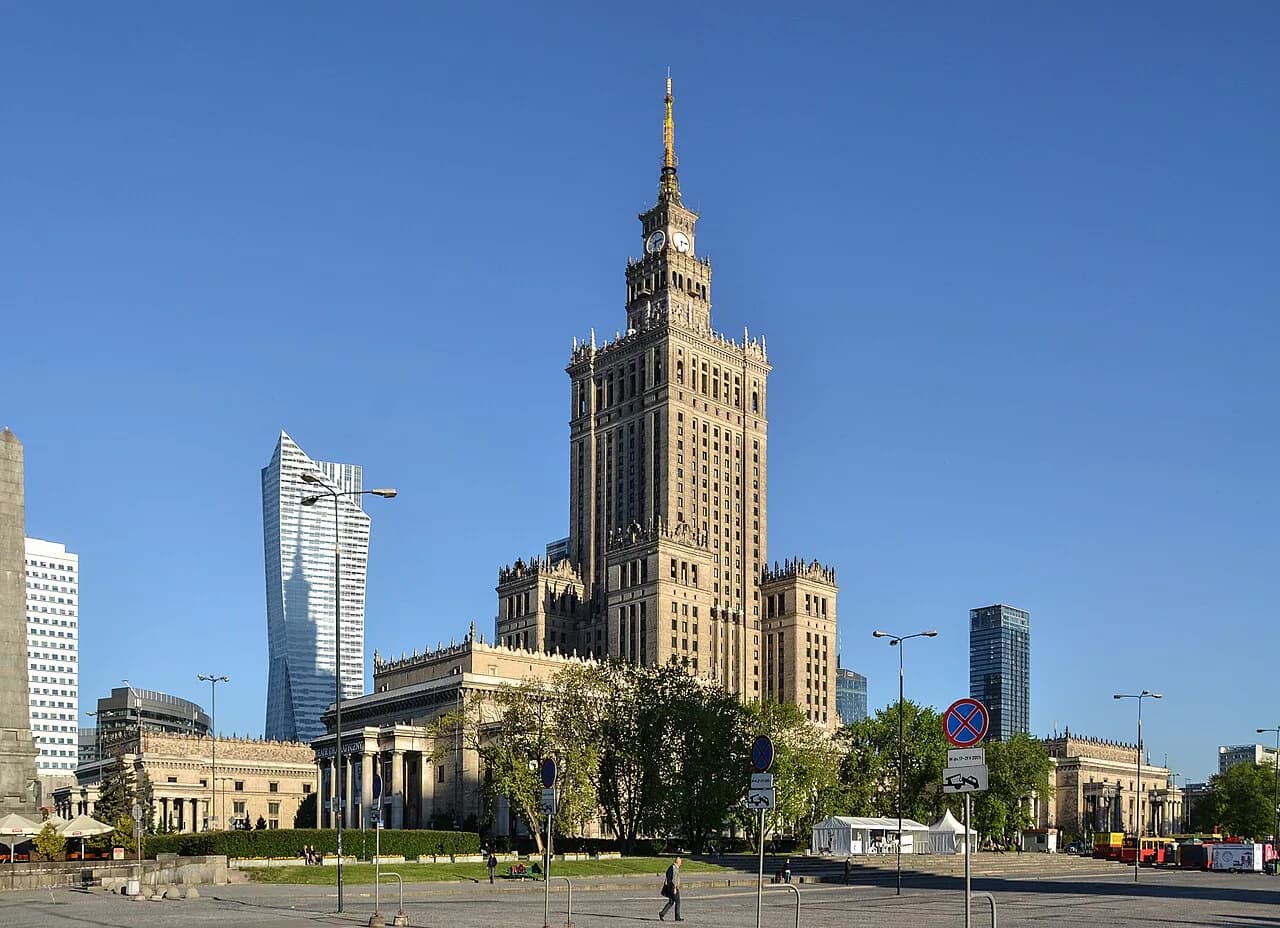
The Palace of Culture and Science dominates the centre and is the obvious starting point, a gift from the Soviet Union in the early 1950s that still defines the skyline. Walk around it at street level as well as looking up: the wide approach avenues and the surrounding open squares were laid out to frame it, and that framing is as much a part of the object as the tower itself.
Nearby, the POLIN Museum of the History of Polish Jews and the Warsaw Rising Museum supply the wartime and post-war context that makes the PRL years intelligible. Both are substantial, and doing one of them properly is a half-day commitment in itself, so pick according to whether you want twentieth-century Jewish history or the 1944 uprising as your anchor.
If you would rather have the era explained by someone else on your feet than read panels, a guided communist tour Warsaw options include the Palace area and the former party buildings; check what each tour actually covers before booking, since the routes differ considerably.
Nowa Huta: reading a planned steel town on foot
Nowa Huta was laid out as a separate socialist-realist town for the steelworks, and its central axis is the reason to make the trip. The wide boulevard, the symmetrical facades and the deliberate framing of views were designed to make walking through it feel ceremonial, which is exactly what you should test by walking it once in each direction.
The layout rewards attention to street names and squares rather than individual buildings; the ensemble is the exhibit. Allow a half day including travel from central Kraków, and accept that the best experience is a slow loop rather than a checklist of addresses.
Gdańsk and the Solidarity legacy
Gdańsk's shipyard is where the 1980 strikes began, and the European Solidarity Centre beside it is the one museum in Poland to prioritise if the 1980s is the chapter you care about. The shipyard is a working industrial landscape as well as a historic one, which is part of its power and part of why you should read up before you arrive.
Combine the yard with a wander round the rebuilt Główne Miasto, which gives you the contrast in a single afternoon: merchant-town brick facades on one side of the water, cranes and gates on the other. Keep the timing honest with yourself and take either the museum or the district walk seriously rather than trying to complete both at speed.
The Gdańsk shipyard is also the place where individual streets carry the history, so a short detour to the gates where the workers gathered is worth planning into the route rather than leaving to chance.
Łódź and Poznań: industry and uprising
Łódź is the industrial counterweight to Warsaw's monumental centre, with a nineteenth-century textile city fabric that the communist state inherited and expanded. It works best as a walking city, where factory walls, courtyards and long streets explain the labour history more directly than an exhibition case does.
Poznań is where the 1956 workers' protest happened, a marker in the standard narrative of resistance to the regime. Treat a Poznań stop as a half day of city walking plus one focused memorial or museum visit, and use it to fill out the 1950s rather than as a standalone PRL destination.
Museums of everyday life under communism
The most engaging PRL collections are the ones that display ordinary objects: milk bars, uniforms, packaging, kitchenware, propaganda posters and reconstructed flats. The point of these displays is scale and texture rather than chronology, and they work well for travellers who want to understand daily life rather than party congresses.
Warsaw's Fabryka Norblina is a useful example of how an industrial site is presented with the factory buildings themselves as part of the setting. Go for the combination of machines, interiors and social history, and allow about two hours unless you read every panel.
Reading the architecture: blocks, avenues and squares
Plattenbau-style blocks are best read in clusters rather than individually. Look for the way the estate connects to the older city, whether tram lines run through it, how much green space sits between buildings and whether the ground floors were designed for shops; those decisions show how the planners expected residents to live.
Monumental squares and avenues of the Stalinist years follow a different logic: symmetry, long sightlines and a building that terminates the view. Once you have seen one example, you will start spotting the same grammar in other Polish cities, which is when the walking starts to pay off.
What a PRL-themed visit costs and how long it takes
Budget in złoty and expect the total to depend almost entirely on how many museums you enter. Museum tickets, guided tours and any boat or tram add-ons each carry their own published rate, so check the venue's own ticket page rather than relying on a guidebook figure, and note that Polish museums commonly publish reduced rates for students and seniors.
Time is the scarcer resource. A realistic plan is one substantial museum plus one district walk per day, which means two days in Warsaw for the palace area and one museum, one day in Gdańsk for the shipyard and the main town, and a half day in Nowa Huta. Anything more becomes a forced march.
Practical notes for the days you plan around
Polish museums often close one day a week, frequently Monday, and some run a free-entry day; confirm the current pattern for each venue on its own site before you build a route around it. Sunday trading is restricted in Poland, so treat Sunday as a day for museums and walking rather than shopping.
Weather shapes the plan more than you would think. Spring runs from March with daytime temperatures typically between 5°C and 15°C, summer sits around 20–25°C, and May, June, September and October are generally the best months for a city break with plenty of walking.
Which PRL day should you book first?
Start with Warsaw and one substantial museum, then add either Nowa Huta or Gdańsk depending on whether socialist-realist planning or the Solidarity story matters more to you. Two days is enough to see the era meaningfully; three lets you add a second city without rushing.
Keep one sentence of advice in mind: a district walked slowly teaches more than a third museum seen tired. Build the trip around that trade-off and the PRL years will make sense as a lived period rather than a list of dates.
Sources
Notes for your next Polish city break
Optional updates to our Poland guides.
You might also like



Continue reading
More guides you'll find useful





